


Page 18 - Encyclopedia of Aquarium and Pond Fish, 3rd Edition
P. 18
16    INTRODUCTION TO FISHKEEPING

         What is a fish?


         Defining a fish is harder than it seems. To most people,   Eye, with outer
                                                           iris and central   Dorsal fin
         it is an animal that lives and breathes in water.   dark pupil                Fin rays
         Some fish, however, emerge onto land, breathe
         air, and use their fins like legs. And many other                                     Body scales
         animals, including amphibians, mammals, and
         invertebrates, live in water. To add further
                                                     Mouth
         confusion, some creatures called fish—starfish,
                                                       Gill cover or
         jellyfish, and cuttlefish—are not really fish at all.  operculum
                                                            Pectoral fin                   Caudal
                                                                                           peduncle
         Fish are vertebrates, which means that—like humans,          Ventral or   Urogenital
                                                                      pelvic fin
         but unlike starfish, jellyfish, and cuttlefish—they possess    Common Goldfish  and anal   Anal fin  Caudal or
                                                                             openings
         a backbone. Most are cold-blooded (ectothermic), so they                                    tail fin
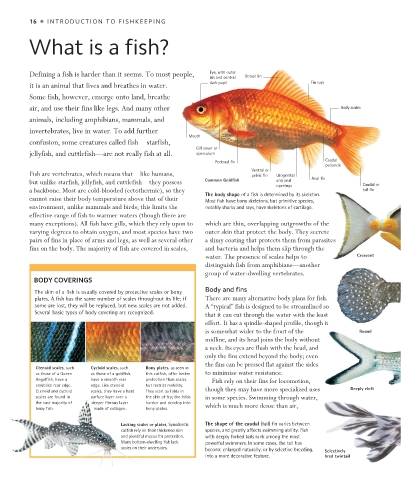
         cannot raise their body temperature above that of their   The body shape of a fish is determined by its skeleton.
                                                          Most fish have bony skeletons, but primitive species,
         environment, unlike mammals and birds; this limits the   notably sharks and rays, have skeletons of cartilage.
         effective range of fish to warmer waters (though there are
         many exceptions). All fish have gills, which they rely upon to   which are thin, overlapping outgrowths of the
         varying degrees to obtain oxygen, and most species have two   outer skin that protect the body. They secrete
         pairs of fins in place of arms and legs, as well as several other   a slimy coating that protects them from parasites
         fins on the body. The majority of fish are covered in scales,   and bacteria and helps them slip through the
                                                          water. The presence of scales helps to   Crescent
                                                          distinguish fish from amphibians—another
                                                          group of water-dwelling vertebrates.
          BODY COVERINGS
           The skin of a fish is usually covered by protective scales or bony   Body and fins
           plates. A fish has the same number of scales throughout its life; if   There are many alternative body plans for fish.
           some are lost, they will be replaced, but new scales are not added.   A “typical” fish is designed to be streamlined so
           Several basic types of body covering are recognized.  that it can cut through the water with the least
                                                          effort. It has a spindle-shaped profile, though it
                                                          is somewhat wider to the front of the     Round
                                                          midline, and its head joins the body without
                                                          a neck. Its eyes are flush with the head, and
                                                          only the fins extend beyond the body; even
                                                          the fins can be pressed flat against the sides
           Ctenoid scales, such    Cycloid scales, such    Bony plates, as seen in
           as those of a Queen   as those of a goldfish,   this catfish, offer better   to minimize water resistance.
           Angelfish, have a   have a smooth rear    protection than scales    Fish rely on their fins for locomotion,
           comblike rear edge.   edge. Like ctenoid    but restrict mobility.
           Ctenoid and cycloid   scales, they have a hard   They start as folds in    though they may have more specialized uses   Deeply cleft
           scales are found in    surface layer over a   the skin of fry; the folds   in some species. Swimming through water,
           the vast majority of   deeper fibrous layer   harden and develop into   which is much more dense than air,
           bony fish.      made of collagen.  bony plates.
                                  Lacking scales or plates, Synodontis   The shape of the caudal (tail) fin varies between
                                  catfish rely on their thickened skin   species, and greatly affects swimming ability. Fish
                                  and plentiful mucus for protection.   with deeply forked tails rank among the most
                                  Many bottom-dwelling fish lack   powerful swimmers. In some cases, the tail has
                                  scales on their undersides.  become enlarged naturally, or by selective breeding,   Selectively
                                                          into a more decorative feature.  bred twintail


   US_016-019_What_is_fish_v2.indd   16                                                              29/08/18   4:08 PM

