


Page 228 - Encyclopedia of Aquarium and Pond Fish, 3rd Edition
P. 228
226    MARINE FISH:   ILLNESS AND TREATMENT


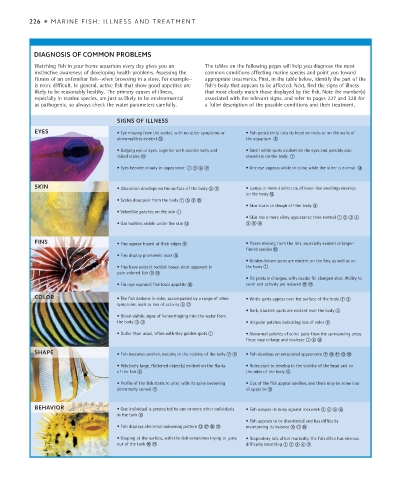
          DIAGNOSIS OF COMMON PROBLEMS
           Watching fish in your home aquarium every day gives you an   The tables on the following pages will help you diagnose the most
           instinctive awareness of developing health problems. Assessing the   common conditions affecting marine species and point you toward
           fitness of an unfamiliar fish—when browsing in a store, for example—   appropriate treatments. First, in the table below, identify the part of the
           is more difficult. In general, active fish that show good appetites are   fish’s body that appears to be affected. Next, find the signs of illness
           likely to be reasonably healthy. The primary causes of illness,   that most closely match those displayed by the fish. Note the number(s)
           especially in marine species, are just as likely to be environmental    associated with the relevant signs, and refer to pages 227 and 228 for
           as pathogenic, so always check the water parameters carefully.  a fuller description of the possible conditions and their treatment.

                                 SIGNS OF ILLNESS
           EYES                  • Eye missing from the socket, with no other symptoms or   • Fish persistently rubs its head on rocks or on the walls of
                                 abnormalities evident ⑮             the aquarium  ⑤
                                 • Bulging eye or eyes, together with swollen belly and    • Small white spots evident on the eyes and possibly also
                                 raised scales ⑭                     elsewhere on the body  ①
                                 • Eyes become cloudy in appearance  ① ② ⑥ ⑨  • One eye appears white in color, while the other is normal  ⑭


           SKIN                  • Ulceration develops on the surface of the body ⑤ ⑨  • Lumps or more distinct cauliflower-like swellings develop
                                                                     on the body ⑫
                                 • Scales disappear from the body ① ⑤ ⑧ ⑮
                                                                     • Skin starts to slough off the body ⑧
                                 • Velvetlike patches on the skin ①
                                                                     • Skin has a more slimy appearance than normal ① ② ③ ④
                                 • Gas bubbles visible under the skin ⑭    ⑤ ⑧ ⑯

           FINS                  • Fins appear frayed at their edges ⑨    • Pieces missing from the fins; especially evident in larger-
                                                                     finned species ⑮
                                 • Fins display prominent tears ⑮
                                                                     • Golden-brown spots are evident on the fins, as well as on
                                 • Fins have evident reddish bases; most apparent in    the body ①
                                 pale-colored fish ⑨ ⑩
                                                                     • Fin posture changes, with caudal fin clamped shut. Ability to
                                 • Fin rays exposed; fish loses appetite ⑩    swim and activity are reduced ⑰ ⑲
           COLOR                 • The fish darkens in color, accompanied by a range of other   • White spots appear over the surface of the body ① ②
                                 symptoms, such as loss of activity ⑤ ⑰
                                                                     • Dark, blackish spots are evident over the body ④
                                 • Blood visible; signs of hemorrhaging into the water from
                                 the body ② ③                        • Irregular patches indicating loss of color ⑨
                                 • Duller than usual, often with tiny golden spots ①    • Abnormal patches of color, paler than the surrounding areas.
                                                                     These may enlarge and coalesce ① ⑪ ⑬
           SHAPE                 • Fish becomes swollen, notably in the vicinity of the belly ⑦ ⑨   • Fish develops an emaciated appearance ⑦ ⑩ ⑪ ⑬ ⑳
                                 • Relatively large, flattened object(s) evident on the flanks    • Holes start to develop in the vicinity of the head and on
                                 of the fish ⑤                       the sides of the body ⑤

                                 • Profile of the fish starts to alter, with its spine becoming   • Lips of the fish appear swollen, and there may be some loss
                                 abnormally curved ⑪                 of appetite ⑲

           BEHAVIOR              • One individual is persecuted by one or more other individuals   • Fish scrapes its body against rockwork ② ④ ⑥ ⑯
                                 in the tank ⑮
                                                                     • Fish appears to be disoriented and has difficulty
                                 • Fish displays abnormal swimming pattern ⑬ ⑰ ⑱ ⑲    maintaining its balance ⑬ ⑰ ⑱
                                 • Gasping at the surface, with the fish sometimes trying to jump   • Respiratory rate alters markedly; the fish often has obvious
                                 out of the tank ⑱ ⑲                 difficulty breathing ① ② ③ ⑥ ⑨


   US_224-229_Illness_M.indd   226                                                                   29/08/18   4:10 PM

