


Page 229 - Encyclopedia of Aquarium and Pond Fish, 3rd Edition
P. 229
HEALTH CONCERNS    227


          PARASITES

           CONDITION      AT RISK        SYMPTOMS                         TREATMENT
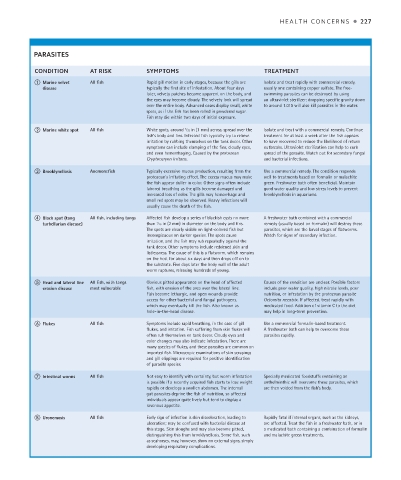
           ①   Marine velvet    All fish  Rapid gill motion in early stages, because the gills are   Isolate and treat rapidly with commercial remedy,
             disease                     typically the first site of infestation. About four days   usually one containing copper sulfate. The free-
                                         later, velvety patches become apparent on the body, and   swimming parasites can be destroyed by using
                                         the eyes may become cloudy. The velvety look will spread   an ultraviolet sterilizer; dropping specific gravity down
                                         over the entire body. Advanced cases display small, white   to around 1.010 will also kill parasites in the water.
                                         spots, as if the fish has been rolled in powdered sugar.
                                         Fish may die within two days of initial exposure.
                                                    1
           ②  Marine white spot   All fish  White spots, around  ⁄32 in (1 mm) across, spread over the   Isolate and treat with a commercial remedy. Continue
                                         fish’s body and fins. Infected fish typically try to relieve   treatment for at least a week after the fish appears
                                         irritation by rubbing themselves on the tank decor. Other   to have recovered to reduce the likelihood of return
                                         symptoms can include clamping of the fins, cloudy eyes,   outbreaks. Ultraviolet sterilization can help to curb
                                         and even hemorrhaging. Caused by the protozoan   spread of the parasite. Watch out for secondary fungal
                                         Cryptocaryon irritans.           and bacterial infections.
           ③  Brooklynellosis  Anemonefish  Typically excessive mucus production, resulting from the   Use a commercial remedy. The condition responds
                                         protozoan’s irritating effect. The excess mucus may make   well to treatments based on formalin or malachite
                                         the fish appear duller in color. Other signs often include   green. Freshwater bath often beneficial. Maintain
                                         labored breathing as the gills become damaged and   good water quality and low stress levels to prevent
                                         increased loss of color. The gills may hemorrhage and   brooklynellosis in aquariums.
                                         small red spots may be observed. Heavy infections will
                                         usually cause the death of the fish.
           ④   Black spot (tang   All fish, including tangs  Affected fish develop a series of blackish cysts no more   A freshwater bath combined with a commercial
                                            1
             turbellarian disease)       than  ⁄16 in (2 mm) in diameter on the body and fins.    remedy (usually based on formalin) will destroy these
                                         The spots are clearly visible on light-colored fish but   parasites, which are the larval stages of flatworms.
                                         inconspicuous on darker species. The spots cause   Watch for signs of secondary infection.
                                         irritation, and the fish may rub repeatedly against the
                                         tank decor. Other symptoms include reddened skin and
                                         listlessness. The cause of this is a flatworm, which remains
                                         on the host for about six days and then drops off on to
                                         the substrate. Five days later the body wall of the adult
                                         worm ruptures, releasing hundreds of young.
           ⑤   Head and lateral line   All fish, with tangs    Obvious pitted appearance on the head of affected    Causes of the condition are unclear. Possible factors
             erosion disease  most vulnerable  fish, with erosion of the area over the lateral line.    include poor water quality, high nitrate levels, poor
                                         Fish become lethargic, and open wounds provide    nutrition, or infestation by the protozoan parasite
                                         access for other bacterial and fungal pathogens,    Octomita necatrix. If affected, treat rapidly with
                                         which may eventually kill the fish. Also known as    medicated food. Addition of vitamin C to the diet
                                         hole-in-the-head disease.        may help in long-term prevention.
           ⑥  Flukes      All fish       Symptoms include rapid breathing, in the case of gill   Use a commercial formalin-based treatment.
                                         flukes, and irritation. Fish suffering from skin flukes will   A freshwater bath can help to overcome these
                                         often rub themselves on tank decor. Cloudy eyes and   parasites rapidly.
                                         color changes may also indicate infestation. There are
                                         many species of flukes, and these parasites are common on
                                         imported fish. Microscopic examinations of skin scrapings
                                         and gill clippings are required for positive identification
                                         of parasite species.
           ⑦  Intestinal worms  All fish  Not easy to identify with certainty, but worm infestation   Specially medicated foodstuffs containing an
                                         is possible if a recently acquired fish starts to lose weight   anthelminthic will overcome these parasites, which
                                         rapidly or develops a swollen abdomen. The internal    are then voided from the fish’s body.
                                         gut parasites deprive the fish of nutrition, so affected
                                         individuals appear quite lively but tend to display a
                                         ravenous appetite.
           ⑧  Uronemosis  All fish       Early sign of infection is skin discoloration, leading to   Rapidly fatal if internal organs, such as the kidneys,
                                         ulceration; may be confused with bacterial disease at    are affected. Treat the fish in a freshwater bath, or in
                                         this stage. Skin sloughs and may also become pitted,   a medicated bath containing a combination of formalin
                                         distinguishing this from brooklynellosis. Some fish, such    and malachite green treatments.
                                         as seahorses, may, however, show no external signs, simply
                                         developing respiratory complications.


   US_224-229_Illness_M.indd   227                                                                   29/08/18   4:10 PM

