


Page 234 - Encyclopedia of Aquarium and Pond Fish, 3rd Edition
P. 234
232    MARINE FISH: BREEDING


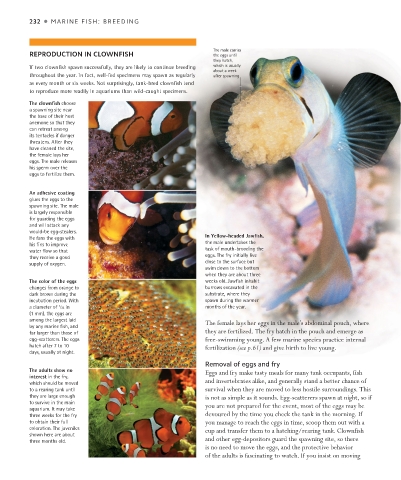
                                                            The male carries
         REPRODUCTION IN CLOWNFISH                          the eggs until
                                                            they hatch,
         If two clownfish spawn successfully, they are likely to continue breeding   which is usually
                                                            about a week
         throughout the year. In fact, well-fed specimens may spawn as regularly   after spawning
         as every month or six weeks. Not surprisingly, tank-bred clownfish tend
         to reproduce more readily in aquariums than wild-caught specimens.
         The clownfish choose
         a spawning site near
         the base of their host
         anemone so that they
         can retreat among
         its tentacles if danger
         threatens. After they
         have cleaned the site,
         the female lays her
         eggs. The male releases
         his sperm over the
         eggs to fertilize them.


         An adhesive coating
         glues the eggs to the
         spawning site. The male
         is largely responsible
         for guarding the eggs
         and will attack any
         would-be egg-stealers.
         He fans the eggs with                            In Yellow-headed Jawfish,
         his fins to improve                              the male undertakes the
         water flow so that                               task of mouth-brooding the
         they receive a good                              eggs. The fry initially live
         supply of oxygen.                                close to the surface but
                                                          swim down to the bottom
                                                          when they are about three
         The color of the eggs                            weeks old. Jawfish inhabit
         changes from orange to                           burrows excavated in the
         dark brown during the                            substrate, where they
         incubation period. With                          spawn during the warmer
         a diameter of  ⁄32 in                            months of the year.
                 1
         (1 mm), the eggs are
         among the largest laid                           The female lays her eggs in the male’s abdominal pouch, where
         by any marine fish, and
         far larger than those of                         they are fertilized. The fry hatch in the pouch and emerge as
         egg-scatterers. The eggs                         free-swimming young. A few marine species practice internal
         hatch after 7 to 10                              fertilization (see p.61) and give birth to live young.
         days, usually at night.
                                                          Removal of eggs and fry
         The adults show no                               Eggs and fry make tasty meals for many tank occupants, fish
         interest in the fry,                             and invertebrates alike, and generally stand a better chance of
         which should be moved
         to a rearing tank until                          survival when they are moved to less hostile surroundings. This
         they are large enough                            is not as simple as it sounds. Egg-scatterers spawn at night, so if
         to survive in the main                           you are not prepared for the event, most of the eggs may be
         aquarium. It may take
         three weeks for the fry                          devoured by the time you check the tank in the morning. If
         to obtain their full                             you manage to reach the eggs in time, scoop them out with a
         coloration. The juveniles                        cup and transfer them to a hatching/rearing tank. Clownfish
         shown here are about
         three months old.                                and other egg-depositors guard the spawning site, so there
                                                          is no need to move the eggs, and the protective behavior
                                                          of the adults is fascinating to watch. If you insist on moving


   US_230-233_Breeding_V4.indd   232                                                                 29/08/18   4:10 PM

