


Page 233 - Encyclopedia of Aquarium and Pond Fish, 3rd Edition
P. 233
REPRODUCTION AND BREEDING    231

         This is a risky breeding strategy, since a large proportion of eggs
         and fry perish. Females lay almost daily during the spawning
         period, producing hundreds of thousands of eggs to increase the   INVERTEBRATE BREEDING
         chances that at least some of their offspring will survive.   Crustaceans and mollusks are rarely bred successfully in aquariums: the
                                                           factors that trigger breeding are difficult to duplicate in tanks, their
         Parental care in marine species                   offspring are devoured by other tank occupants; and the ultraspecific
         Some species, such as clownfish, gobies, and damselfish (see   food needs of the young make rearing nearly impossible.
                                                           Invertebrates such as sponges, anemones, starfish, and corals fare
         pp.240–243) are egg-depositors. These fish lay their eggs close   better, since they can reproduce asexually, with pieces dividing off
         to the substrate or on the reef, attaching them to rocks or   from an existing colony or individual and developing into new
         laying them in caves or shells. They produce far fewer eggs than   organisms. In the wild, they also reproduce sexually, releasing
         egg-scatterers but ensure a higher survival rate by guarding the   eggs and sperm into the open water, as seen in the corals below.
         eggs until they hatch. The well-formed fry then swim to the
         surface, where they feed and develop before returning to the
         reef. Other species, including jawfish (see p.282), are mouth-
         brooders, collecting the eggs in their mouths and incubating
         them there. Mouth-brooding species often lay fewer than 50
         eggs, simply because they cannot fit any more in their mouths.
         Sea horses and pipefish (see p.279) carry their eggs.

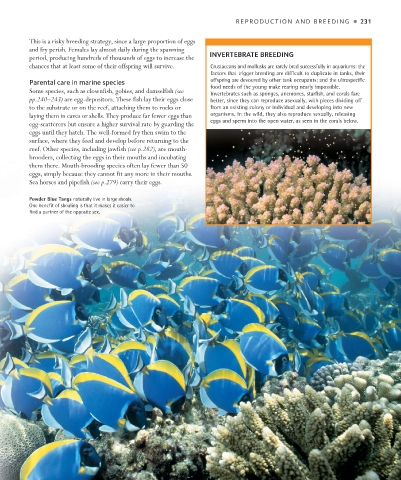
         Powder Blue Tangs naturally live in large shoals.
         One benefit of shoaling is that it makes it easier to
         find a partner of the opposite sex.


   US_230-233_Breeding_V4.indd   231                                                                 29/08/18   4:10 PM

