


Page 232 - Encyclopedia of Aquarium and Pond Fish, 3rd Edition
P. 232
230    MARINE FISH: BREEDING

         Reproduction and breeding


         The breeding habits of tropical marine fish are not well documented
         because only a small number of species have reproduced in captivity.
         A few groups, however, such as clownfish, gobies, and sea horses,
         breed with relative ease. Others, such as angelfish, may spawn
         in aquariums, but their young are so poorly developed when
         they hatch that it is extremely difficult to raise them successfully.

         Ensuring that you have at least one mixed-sex pair from which
         you can breed is problematic with marine fish, since in most
         species the males and females are visually alike. However, if
         the fish can be kept in a group, their behavior should give
         you some clues to the sex of the fish. Two similar-looking
         fish that fight are probably males involved in a territorial
         dispute. Conversely, two fish that get on amicably may well be
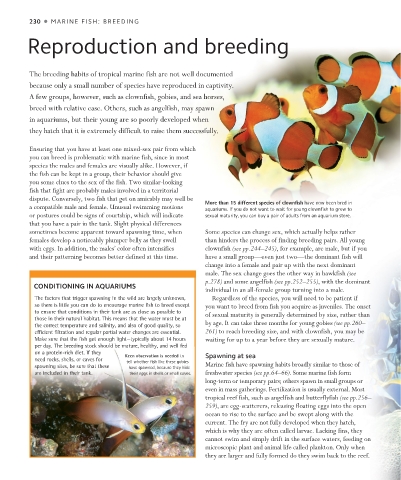
         a compatible male and female. Unusual swimming motions    More than 15 different species of clownfish have now been bred in
                                                          aquariums. If you do not want to wait for young clownfish to grow to
         or postures could be signs of courtship, which will indicate    sexual maturity, you can buy a pair of adults from an aquarium store.
         that you have a pair in the tank. Slight physical differences
         sometimes become apparent toward spawning time, when   Some species can change sex, which actually helps rather
         females develop a noticeably plumper belly as they swell    than hinders the process of finding breeding pairs. All young
         with eggs. In addition, the males’ color often intensifies    clownfish (see pp.244–245), for example, are male, but if you
         and their patterning becomes better defined at this time.  have a small group—even just two—the dominant fish will
                                                          change into a female and pair up with the next dominant
                                                          male. The sex change goes the other way in hawkfish (see
                                                          p.278) and some angelfish (see pp.252–255), with the dominant
          CONDITIONING IN AQUARIUMS
                                                          individual in an all-female group turning into a male.
           The factors that trigger spawning in the wild are largely unknown,   Regardless of the species, you will need to be patient if
           so there is little you can do to encourage marine fish to breed except   you want to breed from fish you acquire as juveniles. The onset
           to ensure that conditions in their tank are as close as possible to   of sexual maturity is generally determined by size, rather than
           those in their natural habitat. This means that the water must be at
           the correct temperature and salinity, and also of good quality, so   by age. It can take three months for young gobies (see pp.260–
           efficient filtration and regular partial water changes are essential.   261) to reach breeding size, and with clownfish, you may be
           Make sure that the fish get enough light—typically about 14 hours   waiting for up to a year before they are sexually mature.
           per day. The breeding stock should be mature, healthy, and well fed
           on a protein-rich diet. If they   Keen observation is needed to    Spawning at sea
           need rocks, shells, or caves for   tell whether fish like these gobies
           spawning sites, be sure that these   have spawned, because they hide   Marine fish have spawning habits broadly similar to those of
           are included in their tank.  their eggs in shells or small caves.  freshwater species (see pp.64–66). Some marine fish form
                                                          long-term or temporary pairs; others spawn in small groups or
                                                          even in mass gatherings. Fertilization is usually external. Most
                                                          tropical reef fish, such as angelfish and butterflyfish (see pp.256–
                                                          259), are egg-scatterers, releasing floating eggs into the open
                                                          ocean to rise to the surface and be swept along with the
                                                          current. The fry are not fully developed when they hatch,
                                                          which is why they are often called larvae. Lacking fins, they
                                                          cannot swim and simply drift in the surface waters, feeding on
                                                          microscopic plant and animal life called plankton. Only when
                                                          they are larger and fully formed do they swim back to the reef.


   US_230-233_Breeding_V4.indd   230                                                                 29/08/18   4:10 PM

