


Page 240 - Encyclopedia of Aquarium and Pond Fish, 3rd Edition
P. 240
238    MARINE FISH DIRECTORY


          Acanthurus sohal                Paracanthurus hepatus
         Sohal Surgeonfish               Blue Tang

           ORIGINS  Also known as the Red Sea Clown Surgeon   ORIGINS  Ranges widely from East Africa through
           because it is confined to the waters of the Red Sea.   the Indian Ocean and across much of the Pacific.
           SIZE  15 ⁄4 in (40 cm).         SIZE  10 in (25 cm).
               3
           DIET  Primarily plant-based foods.   DIET  Mainly vegetarian.
           WATER  Temperature 79–82°F (26–28°C); alkaline   WATER  Temperature 79–82°F (26–28°C); alkaline
           (pH 8.1–8.3) with SG 1.021–1.024.  (pH 8.1–8.3) with SG 1.021–1.024.
           TEMPERAMENT  Intolerant of its own kind.  TEMPERAMENT  Do not mix with any related fish.
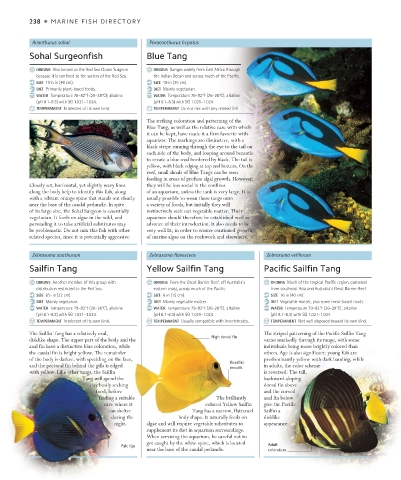
                                         The striking coloration and patterning of the
                                         Blue Tang, as well as the relative ease with which
                                         it can be kept, have made it a firm favorite with
                                         aquarists. The markings are distinctive, with a
                                         black stripe running through the eye to the tail on
                                         each side of the body, and looping around beneath
                                         to create a blue oval bordered by black. The tail is
                                         yellow, with black edging at top and bottom. On the
                                         reef, small shoals of Blue Tangs can be seen
                                         feeding in areas of profuse algal growth. However,
         Closely set, horizontal, yet slightly wavy lines   they will be less social in the confines
         along the body help to identify this fish, along    of an aquarium, unless the tank is very large. It is
         with a vibrant orange spine that stands out clearly   usually possible to wean these tangs onto
         near the base of the caudal peduncle. In spite    a variety of foods, but initially they will
         of its large size, the Sohal Surgeon is essentially   instinctively seek out vegetable matter. Their
         vegetarian. It feeds on algae in the wild, and   aquarium should therefore be established well in
         persuading it to take artificial substitutes may    advance of their introduction. It also needs to be
         be problematic. Do not mix this fish with other   very well lit, in order to ensure continued growth
         related species, since it is potentially aggressive.  of marine algae on the rockwork and elsewhere.

          Zebrasoma xanthurum             Zebrasoma flavescens            Zebrasoma veliferum
         Sailfin Tang                    Yellow Sailfin Tang              Pacific Sailfin Tang

           ORIGINS  Another member of this group with    ORIGINS  From the Great Barrier Reef, off Australia’s   ORIGINS  Much of the tropical Pacific region, eastward
           distribution restricted to the Red Sea.   eastern coast, across much of the Pacific.   from southeast Asia and Australia’s Great Barrier Reef.
           SIZE  8 ⁄2 in (22 cm).          SIZE  6 in (15 cm).              SIZE  16 in (40 cm).
              1
           DIET  Mainly vegetarian.        DIET  Mainly vegetable matter.   DIET  Vegetable matter, plus some meat-based foods.
           WATER  Temperature 79–82°F (26–28°C); alkaline   WATER  Temperature 79–82°F (26–28°C); alkaline   WATER  Temperature 79–82°F (26–28°C); alkaline
           (pH 8.1–8.3) with SG 1.021–1.024.   (pH 8.1–8.3) with SG 1.021–1.024.   (pH 8.1–8.3) with SG 1.021–1.024.
           TEMPERAMENT  Intolerant of its own kind.  TEMPERAMENT  Usually compatible with invertebrates.  TEMPERAMENT  Not well disposed toward its own kind.
         The Sailfin Tang has a relatively oval,                          The striped patterning of the Pacific Sailfin Tang
         disklike shape. The upper part of the body and the   High dorsal fin  varies markedly through its range, with some
         anal fin have a distinctive blue coloration, while               individuals being more brightly colored than
         the caudal fin is bright yellow. The remainder                   others. Age is also significant: young fish are
         of the body is darker, with speckling on the face,               predominantly yellow with dark banding, while
         and the pectoral fin behind the gills is edged          Beaklike   in adults, the color scheme
                                                                 mouth
         with yellow. Like other tangs, the Sailfin                       is reversed. The tall,
                        Tang will spend the                               backward-sloping
                          day busily seeking                              dorsal fin above
                            food, before                                  and the curved
                            finding a suitable               The brilliantly   anal fin below
                              cave where it               colored Yellow Sailfin   give the Pacific
                               can shelter            Tang has a narrow, flattened   Sailfin a
                                during the        body shape. It naturally feeds on   disklike
                                 night.  algae and will require vegetable substitutes to   appearance.
                                         supplement its diet in aquarium surroundings.
                                         When servicing the aquarium, be careful not to
                                         get caught by the white spine, which is located
                                  Pale lips                                Adult
                                         near the base of the caudal peduncle.  coloration


   US_238-239_Surgeons_Tangs.indd   238                                                              29/08/18   4:10 PM

