


Page 244 - Encyclopedia of Aquarium and Pond Fish, 3rd Edition
P. 244
242    MARINE FISH DIRECTORY


          Chromis cyanea
         Blue Chromis

           ORIGINS  Caribbean region, ranging from Florida down
           to the coast of northern South America.
           SIZE  2 in (5 cm).
           DIET  Eats all types of marine fish food.
           WATER  Temperature 77–79°F (25–26°C); alkaline
           (pH 8.1–8.3) with SG 1.020–1.024.
           TEMPERAMENT  Has a territorial disposition.
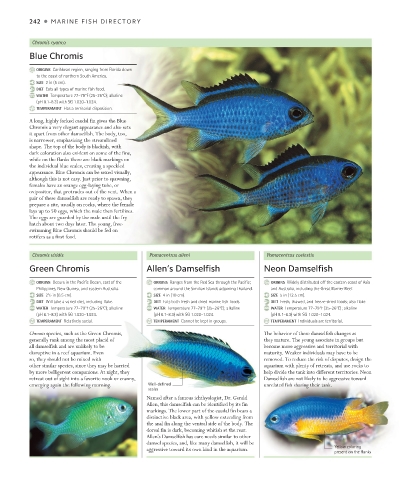
         A long, highly forked caudal fin gives the Blue
         Chromis a very elegant appearance and also sets
         it apart from other damselfish. The body, too,
         is narrower, emphasizing the streamlined
         shape. The top of the body is blackish, with
         dark coloration also evident on some of the fins,
         while on the flanks there are black markings on
         the individual blue scales, creating a speckled
         appearance. Blue Chromis can be sexed visually,
         although this is not easy. Just prior to spawning,
         females have an orange egg-laying tube, or
         ovipositor, that protrudes out of the vent. When a
         pair of these damselfish are ready to spawn, they
         prepare a site, usually on rocks, where the female
         lays up to 50 eggs, which the male then fertilizes.
         The eggs are guarded by the male until the fry
         hatch about two days later. The young, free-
         swimming Blue Chromis should be fed on
         rotifers as a first food.

          Chromis viridis                 Pomacentrus alleni              Pomacentrus coelestis
         Green Chromis                   Allen’s Damselfish               Neon Damselfish

           ORIGINS  Occurs in the Pacific Ocean, east of the   ORIGINS  Ranges from the Red Sea through the Pacific;   ORIGINS  Widely distributed off the eastern coast of Asia
           Philippines, New Guinea, and eastern Australia.     common around the Similian Islands adjoining Thailand.   and Australia, including the Great Barrier Reef.
           SIZE  2 ⁄2 in (6.5 cm).         SIZE  4 in (10 cm).              SIZE  5 in (12.5 cm).
              1
           DIET  Will take a varied diet, including flake.   DIET  Eats both fresh and dried marine fish foods.  DIET  Fresh, thawed, and freeze-dried foods; also flake.
           WATER  Temperature 77–79°F (25–26°C); alkaline   WATER  Temperature 77–79°F (25–26°C); alkaline   WATER  Temperature 77–79°F (25–26°C); alkaline
           (pH 8.1–8.3) with SG 1.020–1.024.   (pH 8.1–8.3) with SG 1.020–1.024.  (pH 8.1–8.3) with SG 1.020–1.024.
           TEMPERAMENT  Relatively social.  TEMPERAMENT  Cannot be kept in groups.  TEMPERAMENT  Individuals are territorial.
         Chromis species, such as the Green Chromis,                      The behavior of these damselfish changes as
         generally rank among the most placid of                          they mature. The young associate in groups but
         all damselfish and are unlikely to be                            become more aggressive and territorial with
         disruptive in a reef aquarium. Even                              maturity. Weaker individuals may have to be
         so, they should not be mixed with                                removed. To reduce the risk of disputes, design the
         other similar species, since they may be harried                 aquarium with plenty of retreats, and use rocks to
         by more belligerent companions. At night, they                   help divide the tank into different territories. Neon
         retreat out of sight into a favorite nook or cranny,             Damselfish are not likely to be aggressive toward
         emerging again the following morning.  Well-defined              unrelated fish sharing their tank.
                                          scales
                                         Named after a famous ichthyologist, Dr. Gerald
                                         Allen, this damselfish can be identified by its fin
                                         markings. The lower part of the caudal fin bears a
                                         distinctive black area, with yellow extending from
                                         the anal fin along the ventral side of the body. The
                                         dorsal fin is dark, becoming whitish at the rear.
                                         Allen’s Damselfish has care needs similar to other
                                         damsel species, and, like many damselfish, it will be
                                         aggressive toward its own kind in the aquarium.     Yellow coloring
                                                                                             present on the flanks


   US_242-243_Damselfish.indd   242                                                                  29/08/18   4:10 PM

