


Page 245 - Encyclopedia of Aquarium and Pond Fish, 3rd Edition
P. 245
DAMSELFISH    243


          Pomacentrus caeruleus           Pomacentrus moluccensis         Microspathodon chrysurus
         Yellow-Bellied Blue Damsel      Lemon Damsel                     Yellowtail Damselfish

           ORIGINS  From the east coast of Africa through the Indo-   ORIGINS  From Indonesia, including the Moluccas, east   ORIGINS  Found in the Caribbean region, from Florida
           Pacific region to eastern Asia and south to Australia.  into the Oceania region of the Pacific.    down to the northern coast of South America.
           SIZE  4 in (10 cm).             SIZE  4 ⁄2 in (11 cm).           SIZE  8 in (20 cm).
                                               1
           DIET  A varied range of marine fish foods.  DIET  Eats all types of marine fish foods.  DIET  Will take prepared and fresh marine foods.
           WATER  Temperature 77–79°F (25–26°C); alkaline   WATER  Temperature 77–79°F (25–26°C); alkaline   WATER  Temperature 77–79°F (25–26°C); alkaline
           (pH 8.1–8.3) with SG 1.020–1.024.   (pH 8.1–8.3) with SG 1.020–1.024.   (pH 8.1–8.3) with SG 1.020–1.024.
           TEMPERAMENT  Intolerant toward its own kind.  TEMPERAMENT  Adults are territorial.  TEMPERAMENT  Tends to quarrel with its own kind.
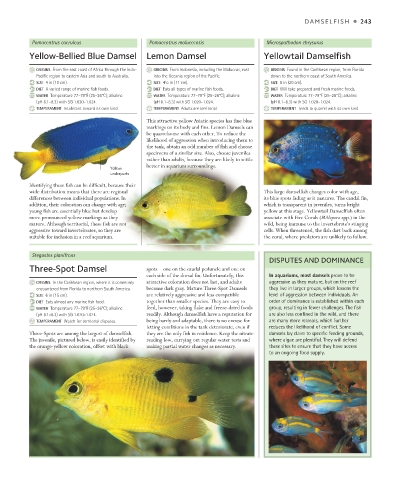
                                         This attractive yellow Asiatic species has fine blue
                                         markings on its body and fins. Lemon Damsels can
                                         be quarrelsome with each other. To reduce the
                                         likelihood of aggression when introducing them to
                                         the tank, obtain an odd number of fish and choose
                                         specimens of a similar size. Also, choose juveniles
                                         rather than adults, because they are likely to settle
                                         better in aquarium surroundings.
                               Yellow
                               underparts
         Identifying these fish can be difficult, because their
         wide distribution means that there are regional                  This large damselfish changes color with age,
         differences between individual populations. In                   its blue spots fading as it matures. The caudal fin,
         addition, their coloration can change with age;                  which is transparent in juveniles, turns bright
         young fish are essentially blue but develop                      yellow at this stage. Yellowtail Damselfish often
         more pronounced yellow markings as they                          associate with Fire Corals (Millepora spp.) in the
         mature. Although territorial, these fish are not                 wild, being immune to the invertebrate’s stinging
         aggressive toward invertebrates, so they are                     cells. When threatened, the fish dart back among
         suitable for inclusion in a reef aquarium.                       the coral, where predators are unlikely to follow.

          Stegastes planifrons
                                                                           DISPUTES AND DOMINANCE
         Three-Spot Damsel               spots—one on the caudal peduncle and one on
                                         each side of the dorsal fin. Unfortunately, this   In aquariums, most damsels prove to be
           ORIGINS  In the Caribbean region, where it is commonly   attractive coloration does not last, and adults   aggressive as they mature, but on the reef
           encountered from Florida to northern South America.   become dark gray. Mature Three-Spot Damsels   they live in larger groups, which lessens the
           SIZE  6 in (15 cm).           are relatively aggressive and less compatible   level of aggression between individuals. An
           DIET  Eats almost any marine fish food.   together than smaller species. They are easy to   order of dominance is established within each
           WATER  Temperature 77–79°F (25–26°C); alkaline   feed, however, taking flake and freeze-dried foods   group, resulting in fewer challenges. The fish
           (pH 8.1–8.3) with SG 1.020–1.024.  readily. Although damselfish have a reputation for   are also less confined in the wild, and there
           TEMPERAMENT  Watch for territorial disputes.  being hardy and adaptable, there is no excuse for   are many more retreats, which further
                                         letting conditions in the tank deteriorate, even if   reduces the likelihood of conflict. Some
         Three-Spots are among the largest of damselfish.   they are the only fish in residence. Keep the nitrate   damsels lay claim to specific feeding grounds,
         The juvenile, pictured below, is easily identified by   reading low, carrying out regular water tests and   where algae are plentiful. They will defend
         the orange-yellow coloration, offset with black   making partial water changes as necessary.  these sites to ensure that they have access
                                                                           to an ongoing food supply.


   US_242-243_Damselfish.indd   243                                                                  29/08/18   4:10 PM

