


Page 241 - Encyclopedia of Aquarium and Pond Fish, 3rd Edition
P. 241
SURGEONFISH AND TANGS    239


                                          Zebrasoma scopas                Naso unicornis
           LOST IN THE CROWD
                                         Brown Tang                       Unicorn Tang
           Aquarists may be puzzled that tangs such
           as these Yellow Sailfins (see opposite) can    ORIGINS  From the Red Sea eastward through the Indo-   ORIGINS  Extends from the Red Sea through the Indo-
           live in groups on the reef, even spawning   Pacific through to the east Pacific.  Pacific region and into the eastern Pacific.
           communally in some cases, without serious   SIZE  8 in (20 cm).  SIZE  28 in (70 cm).
           quarrels developing, yet they cannot be housed   DIET  Predominantly vegetarian.  DIET  Primarily requires vegetable matter.
           together safely in the aquarium. Associating    WATER  Temperature 79–82°F (26–28°C); alkaline   WATER  Temperature 79–82°F (26–28°C); alkaline
           in groups helps to decrease the tangs’ natural   (pH 8.1–8.3) with SG 1.021–1.024.  (pH 8.1–8.3) with SG 1.021–1.024.
           levels of aggression. The large number of fish   TEMPERAMENT  Young fish rarely get along well together.  TEMPERAMENT  Intolerant of its own kind.
           means that particular individuals come into
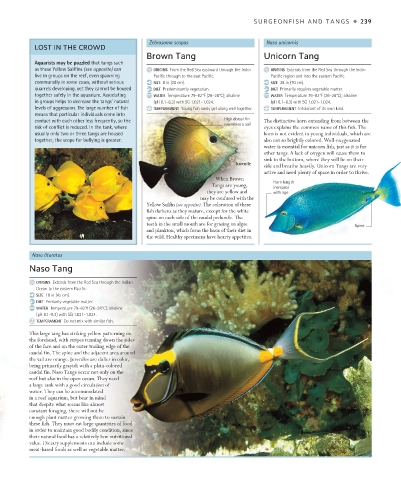
           contact with each other less frequently, so the     High dorsal fin   The distinctive horn extending from between the
           risk of conflict is reduced. In the tank, where     resembles a sail  eyes explains the common name of this fish. The
           usually only two or three tangs are housed                     horn is not evident in young individuals, which are
           together, the scope for bullying is greater.                   also not so brightly colored. Well-oxygenated
                                                                          water is essential for unicorn fish, just as it is for
                                                                          other tangs. A lack of oxygen will cause them to
                                                                          sink to the bottom, where they will lie on their
                                                                  Juvenile  side and breathe heavily. Unicorn Tangs are very
                                                                          active and need plenty of space in order to thrive.
                                                            When Brown
                                                           Tangs are young,   Horn length
                                                                            increases
                                                          they are yellow and   with age
                                                        may be confused with the
                                         Yellow Sailfin (see opposite). The coloration of these
                                         fish darkens as they mature, except for the white
                                         spine on each side of the caudal peduncle. The
                                         teeth in the small mouth are for grazing on algae         Spine
                                         and plankton, which form the basis of their diet in
                                         the wild. Healthy specimens have hearty appetites.

          Naso lituratus
         Naso Tang

           ORIGINS  Extends from the Red Sea through the Indian
           Ocean to the eastern Pacific.
           SIZE  18 in (45 cm).
           DIET  Primarily vegetable matter.
           WATER  Temperature 79–82°F (26–28°C); alkaline
           (pH 8.1–8.3) with SG 1.021–1.024.
           TEMPERAMENT  Do not mix with similar fish.
         This large tang has striking yellow patterning on
         the forehead, with stripes running down the sides
         of the face and on the outer trailing edge of the
         caudal fin. The spine and the adjacent area around
         the tail are orange. Juveniles are duller in color,
         being primarily grayish with a plain-colored
         caudal fin. Naso Tangs occur not only on the
         reef but also in the open ocean. They need
         a large tank with a good circulation of
         water. They can be accommodated
         in a reef aquarium, but bear in mind
         that despite what seems like almost
         constant foraging, there will not be
         enough plant matter growing there to sustain
         these fish. They must eat large quantities of food
         in order to maintain good bodily condition, since
         their natural food has a relatively low nutritional
         value. Dietary supplements can include some
         meat-based foods as well as vegetable matter.


   US_238-239_Surgeons_Tangs.indd   239                                                              29/08/18   4:10 PM

