


Page 29 - Encyclopedia of Aquarium and Pond Fish, 3rd Edition
P. 29
WHAT TO CONSIDER    27

         Feeding and water chemistry
         Food and water requirements can impose real restraints on
         the plants and fish that can be used to stock an aquarium.   EXTERNAL FISH HOUSE
          Some predatory species, for example, can be difficult to   As you become more serious about fishkeeping—and particularly
            wean off life foods, and may have to be fed small fish—   if you want to breed fish—you may find that one tank is just not
              not a practical option for a small home setup. Similarly,   enough. Additional tanks may be needed to isolate young fish from
               if you intend to establish lush, attractive vegetation in   adults or to treat sick fish. If space in the home is limited, a fish
                                                           house may be the answer. This could be a well-insulated and/or
                the tank, you should avoid species that are vegetarian,   heated outbuilding, such as a garage or shed, in which tanks can
                because they will nibble on the young plants.   be supported on racks. Get a building inspector to make sure the
                   Certain tropical fish are highly particular about   building is strong enough to support the weight of tanks and water.
                  water chemistry, while others are tolerant of
                  varied water conditions. Discus, for example,
                  need soft water; if you live in a hard-water area,
                 you will need to invest in an ion-exchange water
                softener to keep these species successfully. However,
              your hard water will be ideal for keeping other species
           that enjoy these conditions, such as Rift Valley cichlids.

         Tanks in the home
         Some aquarists are primarily fascinated by the biology of the
         fish in their tank, or keep their fish for breeding, and are
         almost oblivious to the appearance of the aquarium. But for

                                                          the majority, aesthetics are important—creating a harmonious
                                                          design using the tank itself, the fish, plants, backgrounds, and
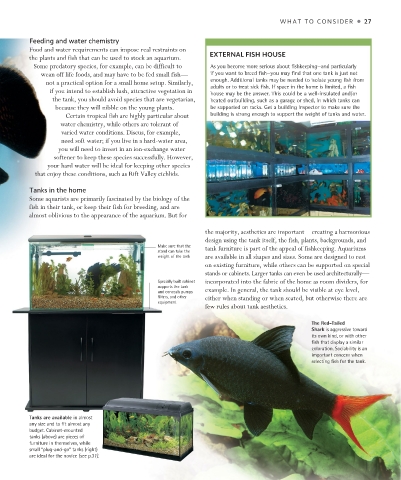
                                             Make sure that the   tank furniture is part of the appeal of fishkeeping. Aquariums
                                             stand can take the
                                             weight of the tank  are available in all shapes and sizes. Some are designed to rest
                                                          on existing furniture, while others can be supported on special
                                                          stands or cabinets. Larger tanks can even be used architecturally—
                                             Specially built cabinet   incorporated into the fabric of the home as room dividers, for
                                             supports the tank
                                             and conceals pumps   example. In general, the tank should be visible at eye level,
                                             filters, and other   either when standing or when seated, but otherwise there are
                                             equipment
                                                          few rules about tank aesthetics.
                                                                                       The Red-Tailed
                                                                                       Shark is aggressive toward
                                                                                       its own kind, or with other
                                                                                       fish that display a similar
                                                                                       coloration. Sociability is an
                                                                                       important concern when
                                                                                       selecting fish for the tank.


         Tanks are available in almost
         any size and to fit almost any
         budget. Cabinet-mounted
         tanks (above) are pieces of
         furniture in themselves, while
         small “plug-and-go“ tanks (right)
         are ideal for the novice (see p.31).


   US_026-027_What_To_Consider.indd   27                                                             29/08/18   4:08 PM

