


Page 34 - Encyclopedia of Aquarium and Pond Fish, 3rd Edition
P. 34
32    FRESHWATER FISH: SETTING UP THE TANK

         Lighting and heating


         To create a thriving aquarium, the natural requirements of its
         inhabitants for light and heat must be matched by artificial means.
         In tropical regions, water temperatures are around 79°F (26°C),
         changing little from one day to the next, while lighting conditions
         vary according to environment and time of day. Modern technology      Safety is paramount when using
                                                                               electricity near water. Rubber caps
         allows the optimum conditions to be created with relative ease.       insulate contacts on fluorescent tubes.

         The need for light
         Almost all animals are dependent on light, and aquarium
         fish are no exception. Many species rely on their sense
         of sight to feed and communicate or use daylight to set
         their internal clocks, which govern many behavioral and
         biological processes. Light is vital for the healthy growth of
         living plants in the tank, and good illumination is necessary
         for showing fish at their best.
                                                              Warm white tube for     Full-spectrum tube
                                                              optimum viewing         for plant growth

          PHOTOSYNTHESIS
           Nearly all plants—terrestrial
           and aquatic—carry out
           photosynthesis. This process   Oxygen
           is vital to all life because it
           allows plants to manufacture
           sugars from carbon dioxide and
           water, which they use as food.        Carbon
           The energy for photosynthesis         dioxide
           comes from sunlight—but some
           wavelengths (colors) of light      Aquarium
           are more effective than            plant
           others in energizing the process.
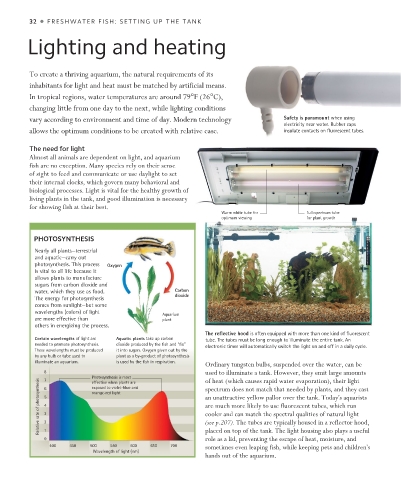
                                                          The reflective hood is often equipped with more than one kind of fluorescent
           Certain wavelengths of light are   Aquatic plants take up carbon    tube. The tubes must be long enough to illuminate the entire tank. An
           needed to promote photosynthesis.   dioxide produced by the fish and “fix”    electronic timer will automatically switch the light on and off in a daily cycle.
           These wavelengths must be produced   it into sugars. Oxygen given out by the
           by any bulb or tube used to    plant as a by-product of photosynthesis
           illuminate an aquarium.  is used by the fish in respiration.  Ordinary tungsten bulbs, suspended over the water, can be
             8                                            used to illuminate a tank. However, they emit large amounts
                          Photosynthesis is most          of heat (which causes rapid water evaporation), their light
             7
            Relative rate of photosynthesis  5 4 3 2  orange-red light  an unattractive yellow pallor over the tank. Today’s aquarists
                          effective when plants are
                                                          spectrum does not match that needed by plants, and they cast
                          exposed to violet-blue and
             6
                                                          are much more likely to use fluorescent tubes, which run
                                                          cooler and can match the spectral qualities of natural light
                                                          (see p.207). The tubes are typically housed in a reflector hood,
                                                          role as a lid, preventing the escape of heat, moisture, and
             0 1                                          placed on top of the tank. The light housing also plays a useful
               400  450   500  550   600   650  700       sometimes even leaping fish, while keeping pets and children’s
                           Wavelength of light (nm)
                                                          hands out of the aquarium.


   US_032-033_Lighting_Heating.indd   32                                                             29/08/18   4:08 PM

