


Page 25 - Encyclopedia of Aquarium and Pond Fish, 3rd Edition
P. 25
THE POPULARITY OF FISHKEEPING     23


                                                           CONSERVATION ISSUES
                                                           The vast majority of freshwater fish offered for sale to the aquarist
                                                           are bred in captivity on a commercial scale. A small proportion of
                                                           freshwater and many marine species, however, are wild-caught for
                                                           the trade. While some people argue that the trade of live animals
                                                           should be banned outright, conservationists increasingly agree that
                                                           the sustainable harvesting of wild fish for the aquarium may benefit
                                                           both fish populations and the wider environment. This is because
                                                           the controlled collection of fish provides lucrative local employment
                                                           and gives governments real incentives to monitor and safeguard
                                                           precious habitats, such as tropical reefs and rain forests.


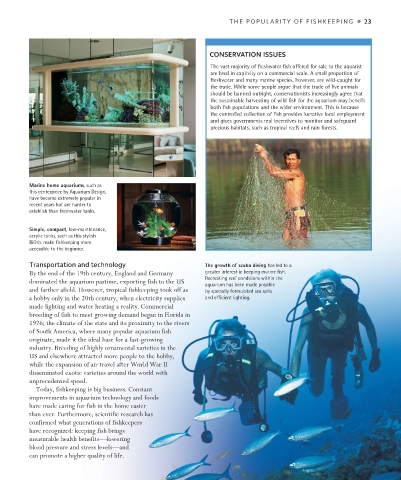
         Marine home aquariums, such as
         this centerpiece by Aquarium Design,
         have become extremely popular in
         recent years but are harder to
         establish than freshwater tanks.

         Simple, compact, low-maintenance,
         acrylic tanks, such as this stylish
         BiOrb, make fishkeeping more
         accessible to the beginner.

         Transportation and technology                    The growth of scuba diving has led to a
         By the end of the 19th century, England and Germany   greater interest in keeping marine fish.
         dominated the aquarium pastime, exporting fish to the US    Recreating reef conditions within the
                                                          aquarium has been made possible
         and farther afield. However, tropical fishkeeping took off as    by specially formulated sea salts
         a hobby only in the 20th century, when electricity supplies   and efficient lighting.
         made lighting and water heating a reality. Commercial
         breeding of fish to meet growing demand began in Florida in
         1926; the climate of the state and its proximity to the rivers
         of South America, where many popular aquarium fish
         originate, made it the ideal base for a fast-growing
         industry. Breeding of highly ornamental varieties in the
         US and elsewhere attracted more people to the hobby,
         while the expansion of air travel after World War II
         disseminated exotic varieties around the world with
         unprecedented speed.
           Today, fishkeeping is big business. Constant
         improvements in aquarium technology and foods
         have made caring for fish in the home easier
         than ever. Furthermore, scientific research has
         confirmed what generations of fishkeepers
         have recognized: keeping fish brings
         measurable health benefits—lowering
         blood pressure and stress levels—and
         can promote a higher quality of life.


   US_022-023_Popularity_V4.indd   23                                                                29/08/18   4:08 PM

