


Page 33 - Encyclopedia of Aquarium and Pond Fish, 3rd Edition
P. 33
CHOOSING THE TANK    31

                                 Tanks and stands
                                 A typical box-shaped tank is
                                 made from panels of glass   SITING THE TANK
                                 held together by a special   •  Choose a firm, level surface;   •  Avoid drafty locations, such
                                 silicone sealant, free from   use a level to make sure    as in a hallway. Never put the tank
                                 chemicals that may harm fish.   the site does not slope.  by a window or anywhere else that
         Colorful accessories like these lids   The silicone forms a strong,   •  Decide on a quiet position by   receives direct sunlight.
         and edging strips can instantly change            an electric outlet where the risk   •  Place glass tanks on styrofoam
         the look of your tank.  watertight bond and is also   of accidental knocks is low but   or a specially made mat to absorb
                                 flexible, to prevent the    with access for maintenance.  unevenness in the surface.
         panels from being pushed apart by the water pressure. Some
         aquariums have a protective frame of plastic or metal, although
         metal is best avoided, since it corrodes. Most tanks come with   Second-hand tanks
         a hood that contains light fixtures and helps reduce    A more economical way of starting off is to buy a second-hand
         evaporation from the water’s surface.            tank. Always check glass tanks carefully for signs of leakage,
           Acrylic tanks are costlier than glass aquariums, but they are   and look for any scratches on the inner
         much stronger and lighter. Acrylic is also clearer than glass   surface of the glass. Such scratches may
         and a better insulator (so the tank loses less heat to the   seem innocuous at the time of purchase,
         surroundings), but it scratches more easily and is harder to   but they will be unsightly if they later
         clean. “Plug-and-go” acrylic tanks can be bought with all the   become colonized by algae, and the algae
         electrical equipment already in place, so you can simply add   will be virtually impossible to remove.
         the substrate and decor, fill the tank, and turn on the power.  Acrylic tanks need to be inspected closely
           Whether you choose glass or acrylic, the finished tank is   for scratches, discoloration, and cracks.
         likely to be heavy—a 20-gallon (90-liter) tank, for example,   Electrical equipment, such as a heater
         can weigh 285 lb (130 kg) when full. Domestic furniture may   or fluorescent tube, is best replaced, and
         not be able to bear such loads, so consider buying a stand or   the wiring should be checked by    Massive
         cabinet that is designed to take the weight of a full tank.  a professional electrician.  tower tank


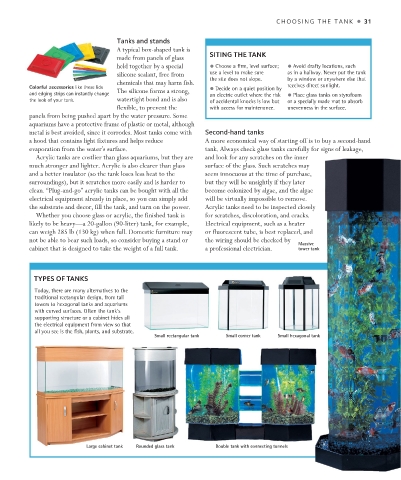
          TYPES OF TANKS
           Today, there are many alternatives to the
           traditional rectangular design, from tall
           towers to hexagonal tanks and aquariums
           with curved surfaces. Often the tank’s
           supporting structure or a cabinet hides all
           the electrical equipment from view so that
           all you see is the fish, plants, and substrate.
                                            Small rectangular tank  Small corner tank  Small hexagonal tank


                         Large cabinet tank  Rounded glass tank  Double tank with connecting tunnels


   US_030-031_Choosing_The_Tanknew_2.indd   31                                                       29/08/18   4:08 PM

