


Page 357 - Encyclopedia of Aquarium and Pond Fish, 3rd Edition
P. 357
KOI    355


          Cyprinus carpio
         Showa
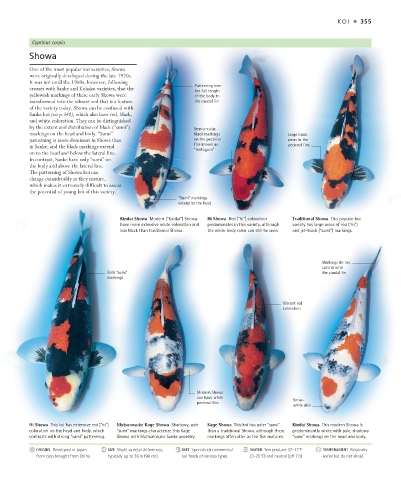
         One of the most popular koi varieties, Showa
         were originally developed during the late 1920s.
         It was not until the 1960s, however, following
         crosses with Sanke and Kohaku varieties, that the   Patterning over
                                                       the full length
         yellowish markings of these early Showa were   of the body to
         transformed into the vibrant red that is a feature   the caudal fin
         of the variety today. Showa can be confused with
         Sanke koi (see p.348), which also have red, black,
         and white coloration. They can be distinguished
         by the extent and distribution of black (“sumi”)   Semicircular,
         markings on the head and body. “Sumi”         black markings           Large black
         patterning is more dominant in Showa than     on the pectoral          areas in the
         in Sanke, and the black markings extend       fins known as            pectoral fins
                                                       “motoguro”
         on to the head and below the lateral line.
         In contrast, Sanke have only “sumi” on
         the body and above the lateral line.
         The patterning of Showa koi can
         change considerably as they mature,
         which makes it extremely difficult to assess
         the potential of young koi of this variety.
                                                  “Sumi” markings
                                                  extend to the head
                                  Kindai Showa  Modern (“Kindai”) Showa   Hi Showa  Red (“hi”) coloration   Traditional Showa  This popular koi
                                  have more extensive white coloration and   predominates in this variety, although    variety has large areas of red (“hi”)
                                  less black than traditional Showa.  the white body color can still be seen.  and jet-black (“sumi”) markings.


                                                                                          Markings do not
                                                                                          extend onto
                               Bold “sumi”                                                the caudal fin
                               markings


                                                                               Vibrant red
                                                                               coloration


                                                       Modern Showa
                                                       can have white             Snow-
                                                       pectoral fins
                                                                                  white skin

         Hi Showa  This koi has extensive red (“hi”)   Matsunosuke Kage Showa  Shadowy, pale   Kage Showa  This koi has paler “sumi”   Kindai Showa  This modern Showa is
         coloration on the head and body, which   “sumi” markings characterize this Kage   than a traditional Showa, although these   predominantly white with pale, shadowy
         contrasts with strong “sumi” patterning.  Showa with Matsunosuko Sanke ancestry.  markings often alter as the fish matures.  “sumi” markings on the head and body.
           ORIGINS  Developed in Japan   SIZE  Slight varietal differences;   DIET  Specialized commercial   WATER  Temperature 37–77°F   TEMPERAMENT  Relatively
           from carp brought from China.  typically up to 36 in (90 cm).  koi foods of various types.  (3–25°C) and neutral (pH 7.0).  social but do not shoal.


   US_354-355_Koi_5.indd   355                                                                       29/08/18   4:11 PM

