


Page 361 - Encyclopedia of Aquarium and Pond Fish, 3rd Edition
P. 361
OTHER COLDWATER FISH    359


          Acipenser gueldenstaedtii       Acipenser stellatus             Acipenser baerii
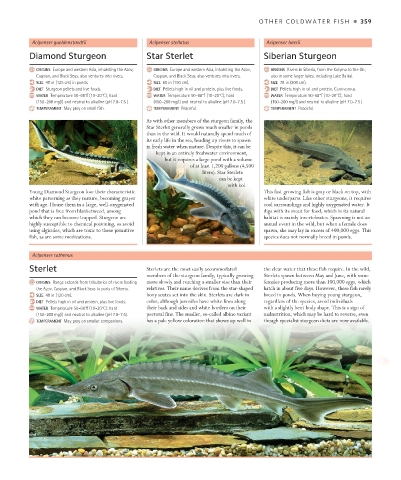
         Diamond Sturgeon                Star Sterlet                     Siberian Sturgeon

           ORIGINS  Europe and western Asia, inhabiting the Azov,   ORIGINS  Europe and western Asia, inhabiting the Azov,   ORIGINS  Rivers in Siberia, from the Kolyma to the Ob;
           Caspian, and Black Seas; also ventures into rivers.   Caspian, and Black Seas; also ventures into rivers.   also in some larger lakes, including Lake Baikal.
           SIZE  48 in (125 cm) in ponds.  SIZE  60 in (150 cm).            SIZE  78 in (200 cm).
           DIET  Sturgeon pellets and live foods.  DIET  Pellets high in oil and protein, plus live foods.  DIET  Pellets high in oil and protein. Carnivorous.
           WATER  Temperature 50–68°F (10–20°C); hard    WATER  Temperature 50–68°F (10–20°C); hard    WATER  Temperature 50–68°F (10–20°C); hard
           (150–200 mg/l) and neutral to alkaline (pH 7.0–7.5 ).   (150–200 mg/l) and neutral to alkaline (pH 7.0–7.5 ).  (150–200 mg/l) and neutral to alkaline (pH 7.0–7.5 ).
           TEMPERAMENT  May prey on small fish.  TEMPERAMENT  Peaceful.     TEMPERAMENT  Peaceful.
                                         As with other members of the sturgeon family, the
                                         Star Sterlet generally grows much smaller in ponds
                                         than in the wild. It would naturally spend much of
                                         its early life in the sea, heading up rivers to spawn
                                         in fresh water when mature. Despite this, it can be
                                            kept in an entirely freshwater environment,
                                              but it requires a large pond with a volume
                                                     of at least 1,200 gallons (4,500
                                                         liters). Star Sterlets
                                                             can be kept
                                                                with koi.
         Young Diamond Sturgeon lose their characteristic                 This fast-growing fish is gray or black on top, with
         white patterning as they mature, becoming grayer                 white underparts. Like other sturgeons, it requires
         with age. House them in a large, well-oxygenated                 cool surroundings and highly oxygenated water. It
         pond that is free from blanketweed, among                        digs with its snout for food, which in its natural
         which they can become trapped. Sturgeon are                      habitat is mainly invertebrates. Spawning is not an
         highly susceptible to chemical poisoning, so avoid               annual event in the wild, but when a female does
         using algicides, which are toxic to these primitive              spawn, she may lay in excess of 400,000 eggs. This
         fish, as are some medications.                                   species does not normally breed in ponds.

          Acipenser ruthenus
         Sterlet                         Sterlets are the most easily accommodated   the clear water that these fish require. In the wild,
                                         members of the sturgeon family, typically growing   Sterlets spawn between May and June, with some
           ORIGINS  Range extends from tributaries of rivers feeding   more slowly and reaching a smaller size than their   females producing more than 100,000 eggs, which
           the Azov, Caspian, and Black Seas to parts of Siberia.   relatives. Their name derives from the star-shaped   hatch in about five days. However, these fish rarely
           SIZE  48 in (120 cm).         bony scutes set into the skin. Sterlets are dark in   breed in ponds. When buying young sturgeon,
           DIET  Pellets high in oil and protein, plus live foods.   color, although juveniles have white lines along   regardless of the species, avoid individuals
           WATER  Temperature 50–68°F (10–20°C); hard    their back and sides and white borders on their   with a slightly bent body shape. This is a sign of
           (150–200 mg/l) and neutral to alkaline (pH 7.0–7.5).   pectoral fins. The smaller, so-called albino variant   malnutrition, which may be hard to reverse, even
           TEMPERAMENT  May prey on smaller companions.  has a pale yellow coloration that shows up well in   though specialist sturgeon diets are now available.


   US_358-359_Other_Coldwater_Fish.indd   359                                                        29/08/18   4:11 PM

