


Page 353 - Encyclopedia of Aquarium and Pond Fish, 3rd Edition
P. 353
KOI    351


          Cyprinus carpio
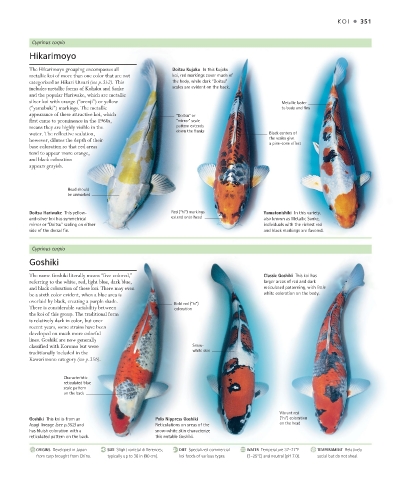
         Hikarimoyo
         The Hikarimoyo grouping encompasses all   Doitsu Kujaku  In this Kujaku
         metallic koi of more than one color that are not   koi, red markings cover much of
         categorized as Hikari Utsuri (see p.352). This   the body, while dark “Doitsu”
         includes metallic forms of Kohaku and Sanke   scales are evident on the back.
         and the popular Hariwake, which are metallic
         silver koi with orange (“orenji”) or yellow                           Metallic luster
         (“yamabuki”) markings. The metallic                                   to body and fins
         appearance of these attractive koi, which   “Doitsu” or
         first came to prominence in the 1960s,   “mirror” scale
         means they are highly visible in the     pattern extends
         water. The reflective scalation,         down the flanks          Black centers of
         however, dilutes the depth of their                               the scales give
                                                                           a pine-cone effect
         base coloration so that red areas
         tend to appear more orange,
         and black coloration
         appears grayish.

                    Head should
                    be unmarked

         Doitsu Hariwake  This yellow-          Red (“hi”) markings       Yamatonishiki  In this variety,
         and-silver koi has symmetrical         extend onto head          also known as Metallic Sanke,
         mirror or “Doitsu” scaling on either                             individuals with the richest red
         side of the dorsal fin.                                          and black markings are favored.

          Cyprinus carpio
         Goshiki

         The name Goshiki literally means “five-colored,”                 Classic Goshiki  This koi has
         referring to the white, red, light blue, dark blue,              larger areas of red and dark
         and black coloration of these koi. There may even                reticulated patterning, with little
         be a sixth color evident, when a blue area is                    white coloration on the body.
         overlaid by black, creating a purple shade.   Bold red (“hi”)
         There is considerable variability between   coloration
         the koi of this group. The traditional form
         is relatively dark in color, but over
         recent years, some strains have been
         developed on much more colorful
         lines. Goshiki are now generally
         classified with Koromo but were              Snow-
         traditionally included in the                white skin
         Kawarimono category (see p.356).

                   Characteristic
                   reticulated blue
                   scale pattern
                   on the back

                                                                              Vibrant red
         Goshiki  This koi is from an       Polo Nippress Goshiki             (“hi”) coloration
         Asagi lineage (see p.352) and      Reticulations on areas of the     on the head
         has bluish coloration with a       snow-white skin characterize
         reticulated pattern on the back.   this notable Goshiki.
           ORIGINS  Developed in Japan   SIZE  Slight varietal differences;   DIET  Specialized commercial   WATER  Temperature 37–77°F   TEMPERAMENT  Relatively
           from carp brought from China.  typically up to 36 in (90 cm).  koi foods of various types.  (3–25°C) and neutral (pH 7.0).  social but do not shoal.


   US_350-351_Koi_3.indd   351                                                                       29/08/18   4:11 PM

