


Page 362 - Encyclopedia of Aquarium and Pond Fish, 3rd Edition
P. 362
360    POND FISH DIRECTORY


          Pimephales promelas             Chrosomus erythrogaster         Rhodeus amarus
         Fathead Minnow                  Southern Red-Bellied Dace        European Bitterling

           ORIGINS  Found through much of North America, from   ORIGINS  North America, extending from Minnesota    ORIGINS  Europe to the north of the Alps, although it
           Canada’s Great Slave Lake southward to Mexico.   eastward to New York State.  does not naturally occur in Scandinavia or Great Britain.
           SIZE  4 in (10 cm).             SIZE  3 ⁄2 in (9 cm).            SIZE  4 in (10 cm).
                                               1
           DIET  Flake and pelleted foods.  DIET  Flake, small pellets, and live foods.  DIET  Eats a wide variety of foodstuffs, including pellets.
           WATER  Temperature 50–77°F (10–25°C); hard    WATER  Temperature 50–77°F (10–25°C); hard    WATER  Temperature 50 –70°F (10–21°C); hard
           (100–150 mg/l) and neutral to alkaline (pH 7.0–7.5).   (100–150 mg/l) and neutral (pH 7.0 ).   (100–150 mg/l) and around neutral (pH 7.0 ).
           TEMPERAMENT  Active and social.  TEMPERAMENT  Relatively peaceful.  TEMPERAMENT  Lively and peaceful.
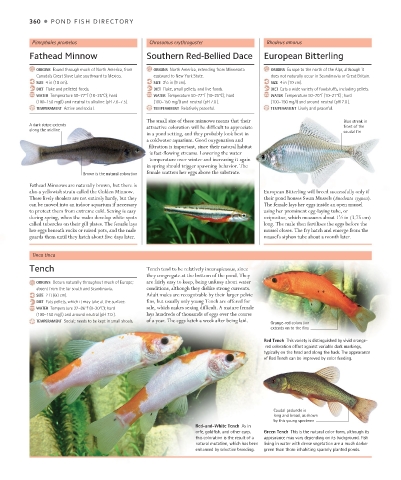
                                         The small size of these minnows means that their       Blue streak in
         A dark stripe extends           attractive coloration will be difficult to appreciate   front of the
         along the midline                                                                      caudal fin
                                         in a pond setting, and they probably look best in
                                         a coldwater aquarium. Good oxygenation and
                                          filtration is important, since their natural habitat
                                          is fast-flowing streams. Lowering the water
                                          temperature over winter and increasing it again
                                         in spring should trigger spawning behavior. The
                        Brown is the natural coloration  female scatters her eggs above the substrate.
         Fathead Minnows are naturally brown, but there is
         also a yellowish strain called the Golden Minnow.                European Bitterling will breed successfully only if
         These lively shoalers are not entirely hardy, but they           their pond houses Swan Mussels (Anodonta cygnea).
         can be moved into an indoor aquarium if necessary                The female lays her eggs inside an open mussel
         to protect them from extreme cold. Sexing is easy                using her prominent egg-laying tube, or
         during spring, when the males develop white spots                ovipositor, which measures about 1 ⁄2 in (3.75 cm)
                                                                                              1
         called tubercles on their gill plates. The female lays           long. The male then fertilizes the eggs before the
         her eggs beneath rocks or raised pots, and the male              mussel closes. The fry hatch and emerge from the
         guards them until they hatch about five days later.              mussel’s siphon tube about a month later.
          Tinca tinca
         Tench                           Tench tend to be relatively inconspicuous, since
                                         they congregate at the bottom of the pond. They
           ORIGINS  Occurs naturally throughout much of Europe;   are fairly easy to keep, being unfussy about water
           absent from the far south and Scandinavia.   conditions, although they dislike strong currents.
           SIZE  2 ft (60 cm).           Adult males are recognizable by their larger pelvic
           DIET  Eats pellets, which it may take at the surface.  fins, but usually only young Tench are offered for
           WATER  Temperature 32–86°F (0–30°C); hard    sale, which makes sexing difficult. A mature female
           (100–150 mg/l) and around neutral (pH 7.0 ).   lays hundreds of thousands of eggs over the course
           TEMPERAMENT  Social; needs to be kept in small shoals.  of a year. The eggs hatch a week after being laid.  Orange-red coloration
                                                                            extends on to the fins
                                                                          Red Tench  This variety is distinguished by vivid orange-
                                                                           red coloration offset against variable dark markings,
                                                                          typically on the head and along the back. The appearance
                                                                          of Red Tench can be improved by color feeding.


                                                                            Caudal peduncle is
                                                                            long and broad, as shown
                                                                            by this young specimen
                                                       Red-and-White Tench  As in
                                                       orfe, goldfish, and other carp,    Green Tench  This is the natural color form, although its
                                                       this coloration is the result of a   appearance may vary depending on its background. Fish
                                                       natural mutation, which has been  living in water with dense vegetation are a much darker
                                                       enhanced by selective breeding.  green than those inhabiting sparsely planted ponds.


   US_360-361_Other_Coldwater_Fish.indd   360                                                        29/08/18   4:11 PM

