


Page 381 - Encyclopedia of Aquarium and Pond Fish, 3rd Edition
P. 381
WATER LILIES AND LOTUSES    379


          Nymphaea capensis               Nymphaea ‘White Delight’
         Cape Blue Water Lily            White Delight                    blend in with the inner petals. The flowers open
                                                                          during the day (some tropical species are night-
           ORIGINS  This popular species occurs naturally in the   ORIGINS  Introduced as recently as 1984, the origins of   flowering) and measure up to 12 in (30 cm) in
           Cape of Good Hope area of South Africa.  this day-blooming water lily are unknown.  diameter. They have a strong scent, which is best
           SIZE  Leaves may spread to about 8 ft (2.5 m).  SIZE  Leaves may spread to about 6 ft (2 m).  appreciated in a conservatory pond setting. New
           WATER  Not fussy about water chemistry. Minimum   WATER  Not fussy about water chemistry. Minimum   leaves are purple-mottled on top but gradually
           temperature 30°F (–1°C).        temperature 30°F (–1°C).       become all green. The leaves are relatively large
           PROPAGATION  Divide the rhizome at the start of the   PROPAGATION  Divide the rhizome at the start of the   and tend to be raised slightly above the water.
           growing period. Can also be grown from seed.  growing period.  ‘White Delight’ reproduces by rhizomes, but some
                                                                          other tropical species produce small plantlets at the
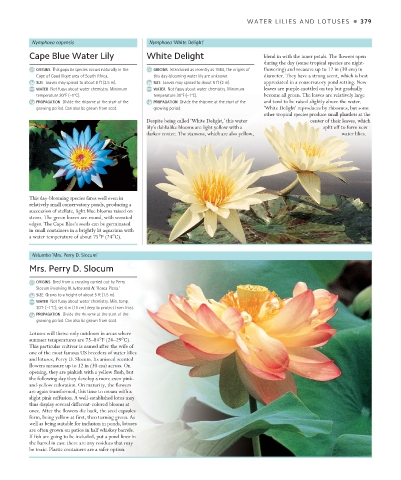
                                         Despite being called ‘White Delight,’ this water   center of their leaves, which
                                         lily’s dahlialike blooms are light yellow with a   split off to form new
                                         darker center. The stamens, which are also yellow,    water lilies.


         This day-blooming species fares well even in
         relatively small conservatory ponds, producing a
         succession of stellate, light blue blooms raised on
         stems. The green leaves are round, with serrated
         edges. The Cape Blue’s seeds can be germinated
         in small containers in a brightly lit aquarium with
         a water temperature of about 75°F (24°C).

          Nelumbo ‘Mrs. Perry D. Slocum’
         Mrs. Perry D. Slocum

           ORIGINS  Bred from a crossing carried out by Perry
           Slocum involving N. lutea and N. ‘Rosea Plena.’
           SIZE  Grows to a height of about 5 ft (1.5 m).
           WATER  Not fussy about water chemistry. Min. temp.
           30°F (–1°C); set 6 in (15 cm) deep to protect from frost.
           PROPAGATION  Divide the rhizome at the start of the
           growing period. Can also be grown from seed.
         Lotuses will thrive only outdoors in areas where
         summer temperatures are 75–84°F (24–29°C).
         This particular cultivar is named after the wife of
         one of the most famous US breeders of water lilies
         and lotuses, Perry D. Slocum. Its aniseed-scented
         flowers measure up to 12 in (30 cm) across. On
         opening, they are pinkish with a yellow flush, but
         the following day they develop a more even pink-
         and-yellow coloration. On maturity, the flowers
         are again transformed, this time to cream with a
         slight pink suffusion. A well-established lotus may
         thus display several different-colored blooms at
         once. After the flowers die back, the seed capsules
         form, being yellow at first, then turning green. As
         well as being suitable for inclusion in ponds, lotuses
         are often grown on patios in half whiskey barrels.
         If fish are going to be included, put a pond liner in
         the barrel in case there are any residues that may
         be toxic. Plastic containers are a safer option.


   US_378-379_Water_Lilies_3.indd   379                                                              29/08/18   4:11 PM

