


Page 380 - Encyclopedia of Aquarium and Pond Fish, 3rd Edition
P. 380
378    POND PLANT DIRECTORY


          Nymphaea ‘James Brydon’                                         Nymphaea x marliacea ‘Chromatella’
         James Brydon                                                     Chromatella

           ORIGINS  Ancestral species probably included N. alba var.        ORIGINS  This cultivar was bred in France from N. alba
           rubra, N. candida, and a N. x laydekeri hybrid.                  crossed with N. mexicana.
           SIZE  Leaves may spread to about 4 ft (1.2 m).                   SIZE  Leaves may spread to about 3 ft (1 m).
           WATER  Not fussy about water chemistry. Hardy to                 WATER  Not fussy about water chemistry. Hardy to
           –30°F (–34°C).                                                   –30°F (–34°C).
           PROPAGATION  Divide the rhizome at the start of the              PROPAGATION  Divide the rhizome at the start of the
           growing period.                                                  growing period.
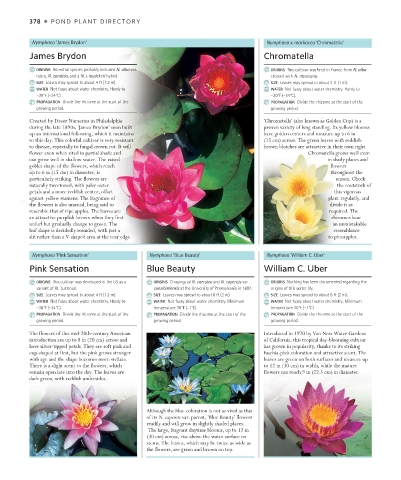
         Created by Dreer Nurseries in Philadelphia                       ‘Chromatella’ (also known as Golden Cup) is a
         during the late 1890s, ‘James Brydon’ soon built                 proven variety of long standing. Its yellow blooms
         up an international following, which it maintains                have golden centers and measure up to 6 in
         to this day. This colorful cultivar is very resistant            (15 cm) across. The green leaves with reddish-
         to disease, especially to fungal crown rot. It will              brown blotches are attractive in their own right.
         flower even when sited in partial shade and                                  Chromatella grows well even
         can grow well in shallow water. The raised                                        in shady places and
         goblet shape of the flowers, which reach                                           flowers
         up to 6 in (15 cm) in diameter, is                                                 throughout the
         particularly striking. The flowers are                                               season. Check
         naturally two-toned, with paler outer                                                the rootstock of
         petals and a more reddish center, offset                                            this vigorous
         against yellow stamens. The fragrance of                                           plant regularly, and
         the flowers is also unusual, being said to                                         divide it as
         resemble that of ripe apples. The leaves are                                       required. The
         an attractive purplish-brown when they first                                       rhizomes bear
         unfurl but gradually change to green. The                                           an unmistakable
         leaf shape is decidedly rounded, with just a                                        resemblance
         slit rather than a V-shaped area at the rear edge.                                 to pineapples.

          Nymphaea ‘Pink Sensation’       Nymphaea ‘Blue Beauty’          Nymphaea ‘William C. Uber’
         Pink Sensation                  Blue Beauty                      William C. Uber

           ORIGINS  This cultivar was developed in the US as a   ORIGINS  Crossings of N. caerulea and N. capensis var.   ORIGINS  Nothing has been documented regarding the
           variant of N. ‘Lustrous’.       zanzibariensis at the University of Pennsylvania in 1897.  origins of this water lily.
           SIZE  Leaves may spread to about 4 ft (1.2 m).  SIZE  Leaves may spread to about 6 ft (2 m).  SIZE  Leaves may spread to about 6 ft (2 m).
           WATER  Not fussy about water chemistry. Hardy to    WATER  Not fussy about water chemistry. Minimum   WATER  Not fussy about water chemistry. Minimum
           –30°F (–34°C).                  temperature 30°F (–1°C).         temperature 30°F (–1°C).
           PROPAGATION  Divide the rhizome at the start of the   PROPAGATION  Divide the rhizome at the start of the   PROPAGATION  Divide the rhizome at the start of the
           growing period.                 growing period.                  growing period.
         The flowers of this mid-20th-century American                    Introduced in 1970 by Van Ness Water Gardens
         introduction are up to 8 in (20 cm) across and                   of California, this tropical day-blooming cultivar
         have silver-tipped petals. They are soft pink and                has grown in popularity, thanks to its striking
         cup-shaped at first, but the pink grows stronger                 fuschia-pink coloration and attractive scent. The
         with age and the shape becomes more stellate.                    leaves are green on both surfaces and measure up
         There is a slight scent to the flowers, which                    to 12 in (30 cm) in width, while the mature
         remain open late into the day. The leaves are                    flowers can reach 9 in (22.5 cm) in diameter.
         dark green, with reddish undersides.


                                         Although the blue coloration is not as vivid as that
                                         of its N. capensis var. parent, ‘Blue Beauty’ flowers
                                         readily and will grow in slightly shaded places.
                                          The large, fragrant daytime blooms, up to 12 in
                                         (30 cm) across, rise above the water surface on
                                         stems. The leaves, which may be twice as wide as
                                         the flowers, are green and brown on top.


   US_378-379_Water_Lilies_3.indd   378                                                              29/08/18   4:11 PM

