


Page 378 - Encyclopedia of Aquarium and Pond Fish, 3rd Edition
P. 378
376    POND PLANT DIRECTORY


          Nymphaea odorata var. minor     Nymphaea odorata ‘Sulphurea Grandiflora’  Nymphaea ‘Rose Airey’
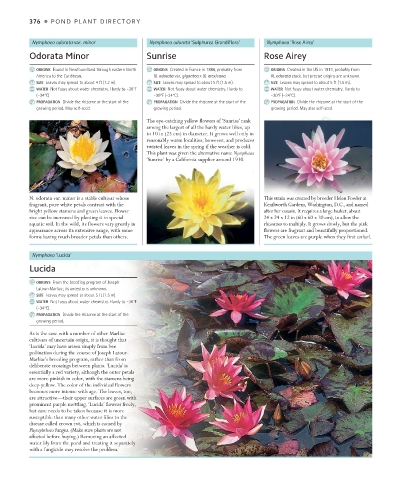
         Odorata Minor                   Sunrise                          Rose Airey

           ORIGINS  Found in Newfoundland through eastern North   ORIGINS  Created in France in 1888, probably from    ORIGINS  Created in the US in 1913, probably from
           America to the Caribbean.       N. odorata var. gigantea x N. mexicana.  N. odorata stock, but precise origins are unknown.
           SIZE  Leaves may spread to about 4 ft (1.2 m).  SIZE  Leaves may spread to about 5 ft (1.5 m).  SIZE  Leaves may spread to about 5 ft (1.5 m).
           WATER  Not fussy about water chemistry. Hardy to –30°F   WATER  Not fussy about water chemistry. Hardy to    WATER  Not fussy about water chemistry. Hardy to
           (–34°C).                        –30°F (–34°C).                   –30°F (–34°C).
           PROPAGATION  Divide the rhizome at the start of the   PROPAGATION  Divide the rhizome at the start of the   PROPAGATION  Divide the rhizome at the start of the
           growing period. May self-seed.  growing period.                  growing period. May also self-seed.
                                         The eye-catching yellow flowers of ‘Sunrise’ rank
                                         among the largest of all the hardy water lilies, up
                                         to 10 in (25 cm) in diameter. It grows well only in
                                         reasonably warm localities, however, and produces
                                         twisted leaves in the spring if the weather is cold.
                                         This plant was given the alternative name Nymphaea
                                         ‘Sunrise’ by a California supplier around 1930.


         N. odorata var. minor is a stable cultivar whose                 This strain was created by breeder Helen Fowler at
         fragrant, pure white petals contrast with the                    Kenilworth Gardens, Washington, D.C., and named
         bright yellow stamens and green leaves. Flower                   after her cousin. It requires a large basket, about
         size can be increased by planting it in special                  24 x 24 x 12 in (60 x 60 x 30 cm), to allow the
         aquatic soil. In the wild, its flowers vary greatly in           rhizomes to multiply. It grows slowly, but the pink
         appearance across its extensive range, with some                 flowers are fragrant and beautifully proportioned.
         forms having much broader petals than others.                    The green leaves are purple when they first unfurl.

          Nymphaea ‘Lucida’
         Lucida

           ORIGINS  From the breeding program of Joseph
           Latour-Marliac; its ancestry is unknown.
           SIZE  Leaves may spread to about 5 ft (1.5 m).
           WATER  Not fussy about water chemistry. Hardy to –30°F
           (–34°C).
           PROPAGATION  Divide the rhizome at the start of the
           growing period.
         As is the case with a number of other Marliac
         cultivars of uncertain origin, it is thought that
         ‘Lucida’ may have arisen simply from bee
         pollination during the course of Joseph Latour-
         Marliac’s breeding program, rather than from
         deliberate crossings between plants. ‘Lucida’ is
         essentially a red variety, although the outer petals
         are more pinkish in color, with the stamens being
         deep yellow. The color of the individual flowers
         becomes more intense with age. The leaves, too,
         are attractive—their upper surfaces are green with
         prominent purple mottling. ‘Lucida’ flowers freely,
         but care needs to be taken because it is more
         susceptible than many other water lilies to the
         disease called crown rot, which is caused by
         Phytophthora fungus. (Make sure plants are not
         affected before buying.) Removing an affected
         water lily from the pond and treating it separately
         with a fungicide may resolve the problem.


   US_376-377_Water_Lilies_2.indd   376                                                              29/08/18   4:11 PM

