


Page 379 - Encyclopedia of Aquarium and Pond Fish, 3rd Edition
P. 379
WATER LILIES AND LOTUSES    377


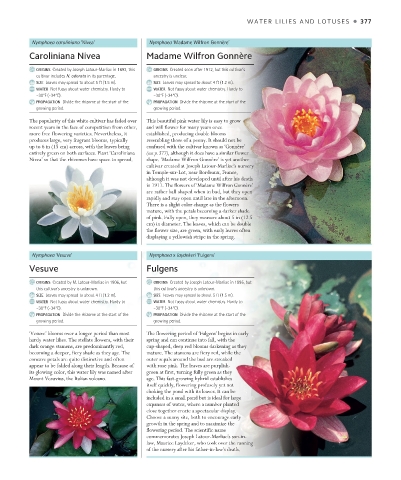
          Nymphaea caroliniana ‘Nivea’    Nymphaea ‘Madame Wilfron Gonnère’
         Caroliniana Nivea               Madame Wilfron Gonnère

           ORIGINS  Created by Joseph Latour-Marliac in 1893, this   ORIGINS  Created soon after 1912, but this cultivar’s
           cultivar includes N. odorata in its parentage.  ancestry is unclear.
           SIZE  Leaves may spread to about 5 ft (1.5 m).  SIZE  Leaves may spread to about 4 ft (1.2 m).
           WATER  Not fussy about water chemistry. Hardy to    WATER  Not fussy about water chemistry. Hardy to
           –30°F (–34°C).                  –30°F (–34°C).
           PROPAGATION  Divide the rhizome at the start of the   PROPAGATION  Divide the rhizome at the start of the
           growing period.                 growing period.
         The popularity of this white cultivar has faded over   This beautiful pink water lily is easy to grow
         recent years in the face of competition from other,   and will flower for many years once
         more free-flowering varieties. Nevertheless, it   established, producing double blooms
         produces large, very fragrant blooms, typically    resembling those of a peony. It should not be
         up to 6 in (15 cm) across, with the leaves being   confused with the cultivar known as ‘Gonnère’
         entirely green on both surfaces. Plant ‘Caroliniana   (see p.377), although it does have a similar flower
         Nivea’ so that the rhizomes have space to spread.  shape. ‘Madame Wilfron Gonnère’ is yet another
                                         cultivar created at Joseph Latour-Marliac’s nursery
                                         in Temple-sur-Lot, near Bordeaux, France,
                                         although it was not developed until after his death
                                         in 1911. The flowers of ‘Madame Wilfron Gonnère’
                                         are rather ball-shaped when in bud, but they open
                                         rapidly and stay open until late in the afternoon.
                                         There is a slight color change as the flowers
                                         mature, with the petals becoming a darker shade
                                         of pink. Fully open, they measure about 5 in (12.5
                                         cm) in diameter. The leaves, which can be double
                                         the flower size, are green, with early leaves often
                                         displaying a yellowish stripe in the spring.

          Nymphaea ‘Vesuve’               Nymphaea x laydekeri ‘Fulgens’
         Vesuve                          Fulgens

           ORIGINS  Created by M. Latour-Marliac in 1906, but    ORIGINS  Created by Joseph Latour-Marliac in 1895, but
           this cultivar’s ancestry is unknown.  this cultivar’s ancestry is unknown.
           SIZE  Leaves may spread to about 4 ft (1.2 m).  SIZE  Leaves may spread to about 5 ft (1.5 m).
           WATER  Not fussy about water chemistry. Hardy to    WATER  Not fussy about water chemistry. Hardy to
           –30°F (–34°C).                  –30°F (–34°C).
           PROPAGATION  Divide the rhizome at the start of the   PROPAGATION  Divide the rhizome at the start of the
           growing period.                 growing period.
         ‘Vesuve’ blooms over a longer period than most   The flowering period of ‘Fulgens’ begins in early
         hardy water lilies. The stellate flowers, with their   spring and can continue into fall, with the
         dark orange stamens, are predominantly red,   cup-shaped, deep red blooms darkening as they
         becoming a deeper, fiery shade as they age. The   mature. The stamens are fiery red, while the
         concave petals are quite distinctive and often   outer sepals around the bud are streaked
         appear to be folded along their length. Because of   with rose pink. The leaves are purplish-
         its glowing color, this water lily was named after   green at first, turning fully green as they
         Mount Vesuvius, the Italian volcano.  age. This fast-growing hybrid establishes
                                         itself quickly, flowering profusely yet not
                                         choking the pond with its leaves. It can be
                                         included in a small pond but is ideal for large
                                         expanses of water, where a number planted
                                         close together create a spectacular display.
                                         Choose a sunny site, both to encourage early
                                         growth in the spring and to maximize the
                                         flowering period. The scientific name
                                         commemorates Joseph Latour-Marliac’s son-in-
                                         law, Maurice Laydeker, who took over the running
                                         of the nursery after his father-in-law’s death.


   US_376-377_Water_Lilies_2.indd   377                                                              29/08/18   4:11 PM

