


Page 135 - (DK) Help Your Kids with Growing Up: A No-Nonsense Guide to Puberty and Adolescence
P. 135
DIGITAL  SELF      133

        Oversharing                                      Avatars
        Social media can be a useful tool for teens to establish   In video games, avatars are three-dimensional electronic images
        friendships, and share memories and thoughts. But   that represent the player in the game and interact with other
        sometimes these shared thoughts can cross the line into   elements of the game. Based on the gaming avatars, two-
        “too much information”. Most people have read a post or   dimensional avatars are increasingly used on social media
        viewed an image uploaded online by a friend, and cringed   platforms, so that users have a visual representation of
        at the intimate details that have been shared with the   themselves without needing to use a photograph. Using an
        world. Being too honest, or “oversharing”, can have   avatar instead of a photograph gives people more control over
        consequences. All information posted online remains   their digital footprints and the information that they are sharing
        online, and if inappropriate or hurtful comments are    with people.
        made, relationships can be damaged as a result.


          P ARENT  TIPS
          Lead by example

          Parents can help their teens to feel comfortable in what
          they are posting by speaking to them about oversharing,
          and by modelling appropriate social media content in their
          own posts.
          • Show your teen how your profile is set to private
           in order to limit who can view posts, and help them
           set theirs, too.
          • Remember that as a parent your teen is unlikely to
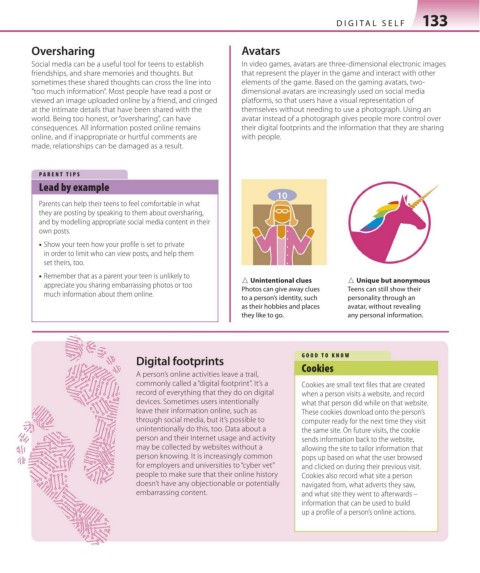
           appreciate you sharing embarrassing photos or too    △ Unintentional clues  △ Unique but anonymous
           much information about them online.           Photos can give away clues    Teens can still show their
                                                         to a person’s identity, such    personality through an
                                                         as their hobbies and places   avatar, without revealing
                                                         they like to go.        any personal information.


                                Digital footprints                     GOOD  T O  KNO W
                                A person’s online activities leave a trail,   Cookies
                                commonly called a “digital footprint”. It’s a   Cookies are small text files that are created
                                record of everything that they do on digital   when a person visits a website, and record
                                devices. Sometimes users intentionally    what that person did while on that website.
                                leave their information online, such as    These cookies download onto the person’s
                                through social media, but it’s possible to   computer ready for the next time they visit
                                unintentionally do this, too. Data about a   the same site. On future visits, the cookie
                                person and their Internet usage and activity   sends information back to the website,
                                may be collected by websites without a   allowing the site to tailor information that
                                person knowing. It is increasingly common    pops up based on what the user browsed
                                for employers and universities to “cyber vet”   and clicked on during their previous visit.
                                people to make sure that their online history   Cookies also record what site a person
                                doesn’t have any objectionable or potentially   navigated from, what adverts they saw,
                                embarrassing content.                  and what site they went to afterwards –
                                                                       information that can be used to build
                                                                       up a profile of a person’s online actions.


   132-133_Digital_self.indd   133                                                                   24/03/2017   17:18

