


Page 180 - (DK) Help Your Kids with Growing Up: A No-Nonsense Guide to Puberty and Adolescence
P. 180
178       F AMILIES


        Dealing with conflict                                              SEE ALSO
                                                                           ‹
                                                                           ‹ 174–175  Parent-teen relationships
                                                                            176–177  Building trust
        Gaining a deeper understanding of their own and others’ boundaries   Difficult events   180–181  ›
        is a vital aspect of growing up for teens, but this can lead to family   Siblings       182–183  ›
        arguments. It's natural for people in close relationships to argue,
        but both teens and parents can learn techniques to defuse conflict.


        Arguments                                 P ARENT  TIPS
        Arguments occur when people feel that they or   Avoiding escalation
        their needs have been misunderstood, or that
        they have not been heard. Often, people find   • Decide whether this is an argument you want to have. Often, teens just want
        themselves in a heated argument over       to get something off their chest, and your best response is to listen and show
        something trivial, but with an underlying issue   understanding for their frustration. Also, by letting some things go, your teen
        that is difficult to talk about. As teens explore and   will recognize that when you do take a stand, you mean it.
        experiment with ideas and values other than   • Avoid arguing in the heat of the moment. Let your teen know that you value
        those of their parents, they are also generally less   their opinion, but that both of you need to be calmer and may need more
        willing to accept a parent’s opinion as the last   time to think the issue through.
        word on a subject.
                                                  • Try not to raise your voice. Shouting can be interpreted as a loss of control,
                                                   and your teen will either shout back or shut down.

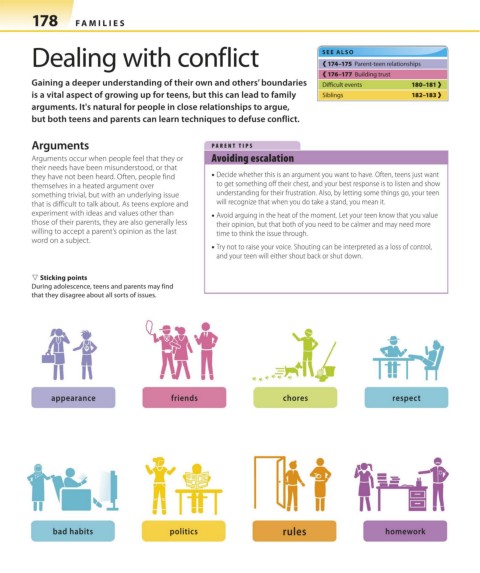
        ▽ Sticking points
        During adolescence, teens and parents may find
        that they disagree about all sorts of issues.


             appearance                 friends                   chores                   respect


             bad habits                 politics                  rules                   homework


   178-179_Dealing_with_conflict.indd   178                                                          24/03/2017   17:19

