


Page 183 - (DK) Help Your Kids with Growing Up: A No-Nonsense Guide to Puberty and Adolescence
P. 183
DIFFICULT  E VENT S       181

        Separation and divorce                                    P ARENT  TIPS

        Most parents start their relationships full of hope for a long future   Supporting your teen
        together, and a shared desire to build a strong and healthy family.
        Over time relationships can change, and this may mean that parents   • Be clear about the fact that they are not a part of,
        feel that their only solution is to separate. How a teen copes is   or reason for, the breakup, and that their relationship
        unique to the individual, but many hold on to a desire for their   will continue with each parent.
        parents to stay together and to work out their problems.  • Refrain from sharing too much with your teen,
                                                                    or expecting them to handle information about
                                                                    your relationship.
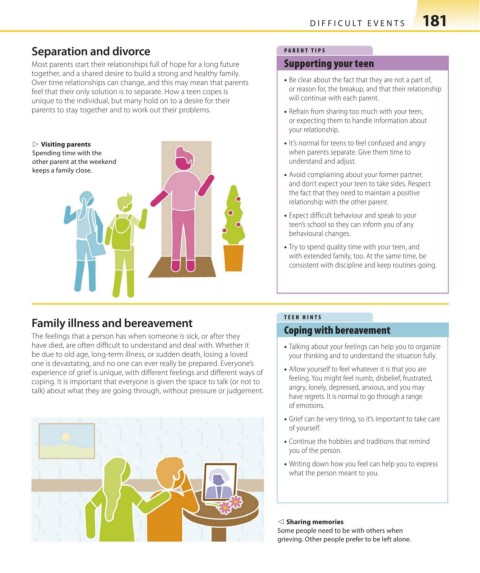
        ▷ Visiting parents                                        • It’s normal for teens to feel confused and angry
        Spending time with the                                      when parents separate. Give them time to
        other parent at the weekend                                 understand and adjust.
        keeps a family close.
                                                                  • Avoid complaining about your former partner,
                                                                    and don’t expect your teen to take sides. Respect
                                                                    the fact that they need to maintain a positive
                                                                    relationship with the other parent.
                                                                  • Expect difficult behaviour and speak to your
                                                                    teen’s school so they can inform you of any
                                                                    behavioural changes.
                                                                  • Try to spend quality time with your teen, and
                                                                    with extended family, too. At the same time, be
                                                                    consistent with discipline and keep routines going.


        Family illness and bereavement                            TEEN  HINTS
        The feelings that a person has when someone is sick, or after they    Coping with bereavement
        have died, are often difficult to understand and deal with. Whether it    • Talking about your feelings can help you to organize
        be due to old age, long-term illness, or sudden death, losing a loved    your thinking and to understand the situation fully.
        one is devastating, and no one can ever really be prepared. Everyone’s
        experience of grief is unique, with different feelings and different ways of   • Allow yourself to feel whatever it is that you are
        coping. It is important that everyone is given the space to talk (or not to   feeling. You might feel numb, disbelief, frustrated,
        talk) about what they are going through, without pressure or judgement.  angry, lonely, depressed, anxious, and you may
                                                                    have regrets. It is normal to go through a range
                                                                    of emotions.
                                                                  • Grief can be very tiring, so it’s important to take care
                                                                    of yourself.
                                                                  • Continue the hobbies and traditions that remind
                                                                    you of the person.
                                                                  • Writing down how you feel can help you to express
                                                                    what the person meant to you.


                                                                 ◁ Sharing memories
                                                                 Some people need to be with others when
                                                                 grieving. Other people prefer to be left alone.


   180-181_Difficult_events.indd   181                                                               24/03/2017   17:19

