


Page 188 - (DK) Help Your Kids with Growing Up: A No-Nonsense Guide to Puberty and Adolescence
P. 188
186       REL ATIONSHIPS


        Communication skills                                               SEE ALSO
                                                                           ‹
                                                                            22–23  Self-expression
                                                                           ‹ 84–85  Emotions
        People communicate and interact with each other in different ways.   ‹ 124–125  Speaking up
        Verbal communication involves speech and non-verbal involves       Interactions         190–191  ›
        body language. Communication depends on many factors, such as
        tone, volume, and vocabulary, as well as expression and movement.

        The importance of communication

        Good communication skills can be learned and will help a person
        in many aspects of life, such as building friendships and during
        job interviews. They can also help people to feel more connected,
        which is important for their happiness and well-being. People
        communicate with each other to share information and socialize,
        which is why communication skills are often called social skills.


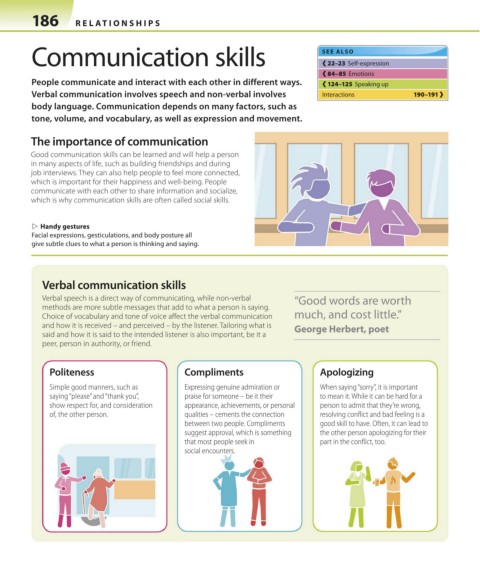
        ▷ Handy gestures
        Facial expressions, gesticulations, and body posture all
        give subtle clues to what a person is thinking and saying.


           Verbal communication skills
           Verbal speech is a direct way of communicating, while non-verbal   “Good words are worth
           methods are more subtle messages that add to what a person is saying.
           Choice of vocabulary and tone of voice affect the verbal communication   much, and cost little.”
           and how it is received – and perceived – by the listener. Tailoring what is   George Herbert, poet
           said and how it is said to the intended listener is also important, be it a
           peer, person in authority, or friend.


            Politeness                     Compliments                     Apologizing
            Simple good manners, such as    Expressing genuine admiration or   When saying “sorry”, it is important
            saying “please” and “thank you”,     praise for someone – be it their   to mean it. While it can be hard for a
            show respect for, and consideration   appearance, achievements, or personal   person to admit that they’re wrong,
            of, the other person.          qualities – cements the connection   resolving conflict and bad feeling is a
                                           between two people. Compliments   good skill to have. Often, it can lead to
                                           suggest approval, which is something   the other person apologizing for their
                                           that most people seek in        part in the conflict, too.
                                           social encounters.


   186-187_Communication_skills.indd   186                                                           24/03/2017   17:19

