


Page 189 - (DK) Help Your Kids with Growing Up: A No-Nonsense Guide to Puberty and Adolescence
P. 189
C OMMUNIC ATION  SKILLS          187

        Listening                                                           TEEN  HINTS
        Good communication requires both                                    Effective communication
        sides to listen well and to speak well.
        To listen well is to think about what                               Good communication can be learned
        the other person is saying, and to show                             and developed.
        attentiveness through nodding, making                               • Maintaining eye contact shows
        listening noises like “uh-huh”, and asking                           interest in what the other person is
        questions about what’s been said. This can                           saying, and confidence in yourself.
        be especially difficult if a person is nervous,
        and thinking about what they are going to                           • Asking the other person’s opinion
        say next, instead of actually listening.                             shows attentiveness to the
                                                                             conversation, and draws the other
                                                                             person into revealing more.
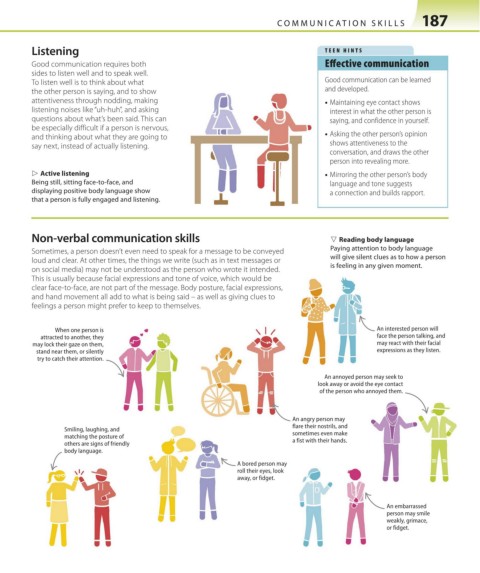
        ▷ Active listening                                                  • Mirroring the other person’s body
        Being still, sitting face-to-face, and                               language and tone suggests
        displaying positive body language show                               a connection and builds rapport.
        that a person is fully engaged and listening.


        Non-verbal communication skills                                      ▽ Reading body language

        Sometimes, a person doesn’t even need to speak for a message to be conveyed   Paying attention to body language
        loud and clear. At other times, the things we write (such as in text messages or   will give silent clues as to how a person
        on social media) may not be understood as the person who wrote it intended.   is feeling in any given moment.
        This is usually because facial expressions and tone of voice, which would be
        clear face-to-face, are not part of the message. Body posture, facial expressions,
        and hand movement all add to what is being said – as well as giving clues to
        feelings a person might prefer to keep to themselves.


              When one person is                                                        An interested person will
          attracted to another, they                                                    face the person talking, and
        may lock their gaze on them,                                                    may react with their facial
         stand near them, or silently                                                   expressions as they listen.
          try to catch their attention.

                                                                            An annoyed person may seek to
                                                                          look away or avoid the eye contact
                                                                           of the person who annoyed them.


                                                                    An angry person may
                                                                    flare their nostrils, and
                Smiling, laughing, and
                matching the posture of                             sometimes even make
                                                                    a fist with their hands.
                others are signs of friendly
                body language.
                                                        A bored person may
                                                        roll their eyes, look
                                                        away, or fidget.

                                                                                          An embarrassed
                                                                                          person may smile
                                                                                          weakly, grimace,
                                                                                          or fidget.


   186-187_Communication_skills.indd   187                                                           24/03/2017   17:19

