


Page 114 - Atlas Of The World's Strangest Animals
P. 114
114      ATLAS  OF THE WORLD’S  STRANGEST ANIMALS


           With their pearl-grey upper parts, snowy under parts and
                                                                    Comparisons
           bold eye stripe, great grey shrikes are strikingly handsome
           birds. Similar in size to the North American wood thrush
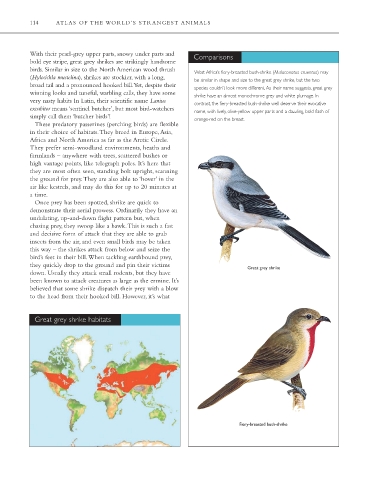
                                                                    West Africa’s fiery-breasted bush-shrike (Malaconotus cruentus) may
           (Hylocichla mustelina), shrikes are stockier, with a long,
                                                                    be similar in shape and size to the great grey shrike, but the two
           broad tail and a pronounced hooked bill.Yet, despite their
                                                                    species couldn’t look more different.As their name suggests, great grey
           winning looks and tuneful, warbling calls, they have some
                                                                    shrike have an almost monochrome grey and white plumage. In
           very nasty habits In Latin, their scientific name Lanius
                                                                    contrast, the fiery-breasted bush-shrike well deserve their evocative
           excubitor means ‘sentinel butcher’, but most bird-watchers
                                                                    name, with lively, olive-yellow upper parts and a dazzling, bold flash of
           simply call them ‘butcher birds’!
                                                                    orange-red on the breast.
             These predatory passerines (perching birds) are flexible
           in their choice of habitats.They breed in Europe, Asia,
           Africa and North America as far as the Arctic Circle.
           They prefer semi-woodland environments, heaths and
           farmlands – anywhere with trees, scattered bushes or
           high vantage points, like telegraph poles. It’s here that
           they are most often seen, standing bolt upright, scanning
           the ground for prey.They are also able to ‘hover’ in the
           air like kestrels, and may do this for up to 20 minutes at
           a time.
             Once prey has been spotted, shrike are quick to
           demonstrate their aerial prowess. Ordinarily they have an
           undulating, up-and-down flight pattern but, when
           chasing prey, they swoop like a hawk.This is such a fast
           and decisive form of attack that they are able to grab
           insects from the air, and even small birds may be taken
           this way – the shrikes attack from below and seize the
           bird’s feet in their bill.When tackling earthbound prey,
           they quickly drop to the ground and pin their victims
                                                                                       Great grey shrike
           down. Usually they attack small rodents, but they have
           been known to attack creatures as large as the ermine. It’s
           believed that some shrike dispatch their prey with a blow
           to the head from their hooked bill. However, it’s what


             Great grey shrike habitats


                                                                                    Fiery-breasted bush-shrike


                                             (c) 2011 Marshall Cavendish. All Rights Reserved.

