


Page 115 - Atlas Of The World's Strangest Animals
P. 115
GREAT GREY SHRIKE             115


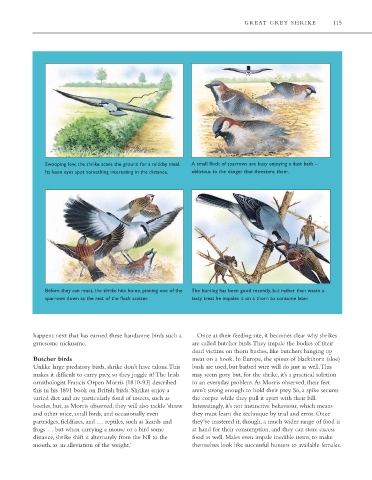
                 Swooping low, the shrike scans the ground for a midday meal.  A small flock of sparrows are busy enjoying a dust bath –
                 Its keen eyes spot something interesting in the distance.  oblivious to the danger that threatens them.


                 Before they can react, the shrike hits home, pinning one of the  The hunting has been good recently, but rather than waste a
                 sparrows down as the rest of the flock scatter.   tasty treat he impales it on a thorn to consume later.


             happens next that has earned these handsome birds such a  Once at their feeding site, it becomes clear why shrikes
             gruesome nickname.                                     are called butcher birds.They impale the bodies of their
                                                                    dead victims on thorn bushes, like butchers hanging up
             Butcher birds                                          meat on a hook. In Europe, the spines of blackthorn (sloe)
             Unlike large predatory birds, shrike don’t have talons.This  bush are used, but barbed wire will do just as well.This
             makes it difficult to carry prey, so they juggle it! The Irish  may seem gory but, for the shrike, it’s a practical solution
             ornithologist Francis Orpen Morris (1810-93) described  to an everyday problem.As Morris observed, their feet
             this in his 1891 book on British birds. Shrikes enjoy a  aren’t strong enough to hold their prey. So, a spike secures
             varied diet and are particularly fond of insects, such as  the corpse while they pull it apart with their bill.
             beetles, but, as Morris observed, they will also tackle ‘shrew  Interestingly, it’s not instinctive behaviour, which means
             and other mice, small birds, and occasionally even     they must learn the technique by trial and error. Once
             partridges, fieldfares, and … reptiles, such as lizards and  they’ve mastered it, though, a much wider range of food is
             frogs … but when carrying a mouse or a bird some       at hand for their consumption, and they can store excess
             distance, shrike shift it alternately from the bill to the  food as well. Males even impale inedible items, to make
             mouth, as an alleviation of the weight.’               themselves look like successful hunters to available females.


                                             (c) 2011 Marshall Cavendish. All Rights Reserved.

