


Page 145 - Atlas Of The World's Strangest Animals
P. 145
PYGMY MARMOSET              145


             cryptic coloration, combined with catlike stealth and
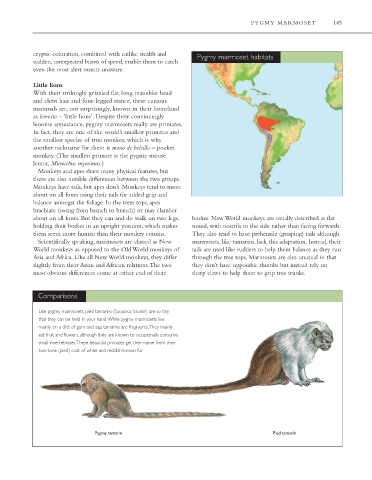
                                                                     Pygmy marmoset habitats
             sudden, unexpected bursts of speed, enable them to catch
             even the most alert insects unaware.


             Little lions
             With their strikingly grizzled fur, long manelike head
             and chest hair and four-legged stance, these curious
             mammals are, not surprisingly, known in their homeland
             as leoncito – ‘little lions’. Despite their convincingly
             leonine appearance, pygmy marmosets really are primates.
             In fact, they are one of the world’s smallest primates and
             the smallest species of true monkey, which is why
             another nickname for them is mono de bolsillo – pocket
             monkey. (The smallest primate is the pygmy mouse
             lemur, Microcebus myoxinus.)
              Monkeys and apes share many physical features, but
             there are also notable differences between the two groups.
             Monkeys have tails, but apes don’t. Monkeys tend to move
             about on all fours using their tails for added grip and
             balance amongst the foliage. In the trees tops, apes
             brachiate (swing from branch to branch) or may clamber
             about on all fours. But they can and do walk on two legs,  bodies. New World monkeys are usually described as flat
             holding their bodies in an upright position, which makes  nosed, with nostrils to the side rather than facing forwards.
             them seem more human than their monkey cousins.        They also tend to have prehensile (grasping) tails although
              Scientifically speaking, marmosets are classed as New  marmosets, like tamarins, lack this adaptation. Instead, their
             World monkeys as opposed to the Old World monkeys of   tails are used like rudders to help them balance as they run
             Asia and Africa. Like all New World monkeys, they differ  through the tree tops. Marmosets are also unusual in that
             slightly from their Asian and African relations.The two  they don’t have opposable thumbs but instead rely on
             most obvious differences come at either end of their   sharp claws to help them to grip tree trunks.


              Comparisons


              Like pygmy marmosets, pied tamarins (Saquinus bicolor) are so tiny
              that they can be held in your hand.While pygmy marmosets live
              mainly on a diet of gum and sap, tamarins are frugivores.They mainly
              eat fruit and flowers, although they are known to occasionally consume
              small invertebrates.These beautiful primates get their name from their
              two-tone (pied) coat of white and reddish-brown fur.


                                  Pygmy tamarin                                                Pied tamarin


                                             (c) 2011 Marshall Cavendish. All Rights Reserved.

