


Page 144 - Atlas Of The World's Strangest Animals
P. 144
144      ATLAS  OF THE WORLD’S  STRANGEST ANIMALS


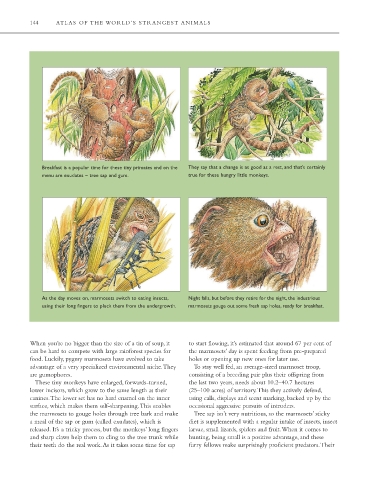
                Breakfast is a popular time for these tiny primates and on the  They say that a change is as good as a rest, and that’s certainly
                menu are exudates –tree sap and gum.              true for these hungry little monkeys.


                As the day moves on, marmosets switch to eating insects,  Night falls, but before they retire for the night, the industrious
                using their long fingers to pluck them from the undergrowth.  marmosets gouge out some fresh sap holes, ready for breakfast.


           When you’re no bigger than the size of a tin of soup, it  to start flowing, it’s estimated that around 67 per cent of
           can be hard to compete with large rainforest species for  the marmosets’ day is spent feeding from pre-prepared
           food. Luckily, pygmy marmosets have evolved to take    holes or opening up new ones for later use.
           advantage of a very specialized environmental niche.They  To stay well fed, an average-sized marmoset troop,
           are gumophores.                                        consisting of a breeding pair plus their offspring from
             These tiny monkeys have enlarged, forwards-turned,   the last two years, needs about 10.2–40.7 hectares
           lower incisors, which grow to the same length as their  (25–100 acres) of territory.This they actively defend,
           canines.The lower set has no hard enamel on the inner  using calls, displays and scent marking, backed up by the
           surface, which makes them self-sharpening.This enables  occasional aggressive pursuits of intruders.
           the marmosets to gouge holes through tree bark and make  Tree sap isn’t very nutritious, so the marmosets’ sticky
           a meal of the sap or gum (called exudates), which is   diet is supplemented with a regular intake of insects, insect
           released. It’s a tricky process, but the monkeys’ long fingers  larvae, small lizards, spiders and fruit.When it comes to
           and sharp claws help them to cling to the tree trunk while  hunting, being small is a positive advantage, and these
           their teeth do the real work.As it takes some time for sap  furry fellows make surprisingly proficient predators.Their


                                             (c) 2011 Marshall Cavendish. All Rights Reserved.

