


Page 149 - Atlas Of The World's Strangest Animals
P. 149
RED HOWLER MONKEY                149


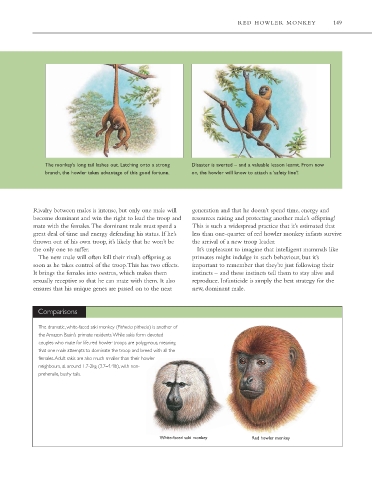
                 The monkey’s long tail lashes out. Latching onto a strong  Disaster is averted – and a valuable lesson learnt. From now
                 branch, the howler takes advantage of this good fortune.  on, the howler will know to attach a ‘safety line’!


             Rivalry between males is intense, but only one male will  generation and that he doesn’t spend time, energy and
             become dominant and win the right to lead the troop and  resources raising and protecting another male’s offspring!
             mate with the females.The dominant male must spend a   This is such a widespread practice that it’s estimated that
             great deal of time and energy defending his status. If he’s  less than one-quarter of red howler monkey infants survive
             thrown out of his own troop, it’s likely that he won’t be  the arrival of a new troop leader.
             the only one to suffer.                                 It’s unpleasant to imagine that intelligent mammals like
              The new male will often kill their rival’s offspring as  primates might indulge in such behaviour, but it’s
             soon as he takes control of the troop.This has two effects.  important to remember that they’re just following their
             It brings the females into oestrus, which makes them   instincts – and these instincts tell them to stay alive and
             sexually receptive so that he can mate with them. It also  reproduce. Infanticide is simply the best strategy for the
             ensures that his unique genes are passed on to the next  new, dominant male.


              Comparisons

              The dramatic, white-faced saki monkey (Pithecia pithecia) is another of
              the Amazon Basin’s primate residents.While sakis form devoted
              couples who mate for life, red howler troops are polygynous, meaning
              that one male attempts to dominate the troop and breed with all the
              females.Adult sakis are also much smaller than their howler
              neighbours, at around 1.7-2kg (3.7–4.4lb), with non-
              prehensile, bushy tails.


                                                        White-faced saki monkey         Red howler monkey


                                             (c) 2011 Marshall Cavendish. All Rights Reserved.

