


Page 178 - Atlas Of The World's Strangest Animals
P. 178
178      ATLAS  OF THE WORLD’S  STRANGEST ANIMALS


             Comparisons

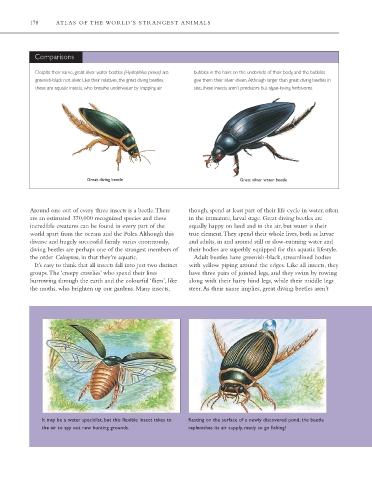
             Despite their name, great silver water beetles (Hydrophilus piceus) are  bubbles in the hairs on the underside of their body, and the bubbles
             greenish-black not silver. Like their relatives, the great diving beetles,  give them their silver sheen.Although larger than great diving beetles in
             these are aquatic insects, who breathe underwater by trapping air  size, these insects aren’t predators but algae-loving herbivores.


                               Great diving beetle                                  Great silver water beetle


           Around one out of every three insects is a beetle.There   though, spend at least part of their life cycle in water, often
           are an estimated 370,000 recognized species and these  in the immature, larval stage. Great diving beetles are
           incredible creatures can be found in every part of the  equally happy on land and in the air, but water is their
           world apart from the oceans and the Poles.Although this  true element.They spend their whole lives, both as larvae
           diverse and hugely successful family varies enormously,  and adults, in and around still or slow-running water and
           diving beetles are perhaps one of the strangest members of  their bodies are superbly equipped for this aquatic lifestyle.
           the order Coleoptera, in that they’re aquatic.           Adult beetles have greenish-black, streamlined bodies
             It’s easy to think that all insects fall into just two distinct  with yellow piping around the edges. Like all insects, they
           groups.The ‘creepy crawlies’ who spend their lives     have three pairs of jointed legs, and they swim by rowing
           burrowing through the earth and the colourful ‘fliers’, like  along with their hairy hind legs, while their middle legs
           the moths, who brighten up our gardens. Many insects,  steer.As their name implies, great diving beetles aren’t


                It may be a water specialist, but this flexible insect takes to  Resting on the surface of a newly discovered pond, the beetle
                the air to spy out new hunting grounds.           replenishes its air supply, ready to go fishing!


                                             (c) 2011 Marshall Cavendish. All Rights Reserved.

