


Page 212 - Atlas Of The World's Strangest Animals
P. 212
212      ATLAS  OF THE WORLD’S  STRANGEST ANIMALS


                                                                  in some species, sharp, rasping claws.They also have two
             Opalescent squid habitats
                                                                  longer tentacles, with suckers on the end, which are used
                                                                  to grasp prey and pull it towards the arms.This extra set of
                                                                  tentacles makes them decapods, not octopods.The mouth
                                                                  itself sits in the centre of this writhing mass, and contains a
                                                                  horny beak that is used to break open tough shells.A
                                                                  poison gland lies just inside the jaws, and the poison
                                                                  disables the prey, making it easier to dissect.
                                                                    These brilliantly colourful creatures reach sexual
                                                                  maturity at 4–8 months, when they collect near the coast
                                                                  to spawn.With a specially adapted arm, males deposit their
                                                                  sperm inside the females’ bodies using pre-prepared
                                                                  packages called spermatophores. She then ejects her eggs
                                                                  in jelly-filled sacs. It used to be believed that opalescent
                                                                  squid died immediately after spawning. Death certainly
                                                                  follows very soon afterwards, but adults may survive to
                                                                  repeat the procedure numerous times in the weeks before
                                                                  they die. Once hatched, little is known about how the tiny
                                                                  paralarvae survive, but it’s likely they travel to the surface
                                                                  to feed. It takes around two months before they grow big
                                                                  enough to hunt as adults and at least another two before
           Squid are a type of marine cephalopod.These odd-looking  they’re ready to breed.
           creatures are descended from molluscs, but their bodies are
           dramatically different. Unlike their ancestors, which had a  Added extras
           hard outer shell, squid have soft exteriors.Their bodies are  Once they’re fully grown, opalescent squid are formidable
           long and tube-shaped, with a small head.The word       hunters and use a range of adaptations both to catch prey
           cephalopod means ‘head footed’ because, like octopi, squid  and to avoid becoming prey themselves.
           have eight, strong, flexible arms that are attached directly  In the wild, the skin of these colourful cephalopods
           to the head.These are lined with two rows of suckers and,  ranges from white to brown, but they can change their


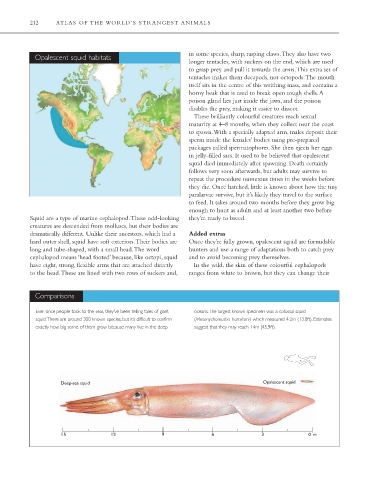
             Comparisons


             Ever since people took to the seas, they’ve been telling tales of giant  oceans.The largest known specimen was a colossal squid
             squid.There are around 300 known species, but it’s difficult to confirm  (Mesonychoteuthis hamiltoni) which measured 4.2m (13.8ft). Estimates
             exactly how big some of them grow because many live in the deep  suggest that they may reach 14m (45.9ft).


                      Deep-sea squid                                                        Opalescent squid


                      15               12                9                6                3                0  m


                                             (c) 2011 Marshall Cavendish. All Rights Reserved.

