


Page 76 - Atlas Of The World's Strangest Animals
P. 76
76       ATLAS  OF THE WORLD’S  STRANGEST ANIMALS


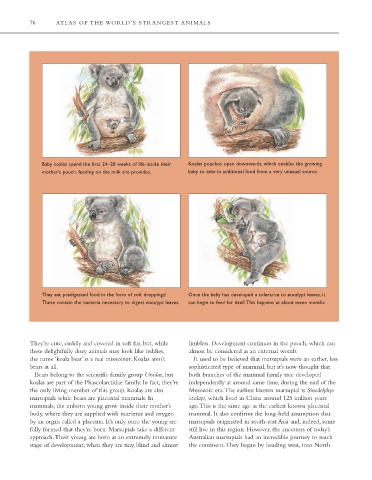
                Baby koalas spend the first 24–28 weeks of life inside their  Koalas pouches open downwards,which enables the growing
                mother’s pouch, feeding on the milk she provides.  baby to take in additional food from a very unusual source.


                They eat predigested food in the form of soft droppings!  Once the baby has developed a tolerance to eucalypt leaves, it
                These contain the bacteria necessary to digest eucalypt leaves.  can begin to feed for itself.This happens at about seven months.


           They’re cute, cuddly and covered in soft fur, but, while  limbless. Development continues in the pouch, which can
           these delightfully dozy animals may look like teddies,  almost be considered as an external womb.
           the name ‘koala bear’ is a real misnomer. Koalas aren’t  It used to be believed that marsupials were an earlier, less
           bears at all.                                          sophisticated type of mammal, but it’s now thought that
             Bears belong to the scientific family group Ursidae,but  both branches of the mammal family tree developed
           koalas are part of the Phascolarctidae family. In fact, they’re  independently at around same time, during the end of the
           the only living member of this group. Koalas are also  Mesozoic era.The earliest known marsupial is Sinodelphys
           marsupials while bears are placental mammals. In       szalayi, which lived in China around 125 million years
           mammals, the unborn young grow inside their mother’s   ago.This is the same age as the earliest known placental
           body, where they are supplied with nutrients and oxygen  mammal. It also confirms the long-held assumption that
           by an organ called a placenta. It’s only once the young are  marsupials originated in south-east Asia and, indeed, some
           fully formed that they’re born. Marsupials take a different  still live in this region. However, the ancestors of today’s
           approach.Their young are born at an extremely immature  Australian marsupials had an incredible journey to reach
           stage of development, when they are tiny, blind and almost  the continent.They began by heading west, into North


                                             (c) 2011 Marshall Cavendish. All Rights Reserved.

