


Page 81 - Atlas Of The World's Strangest Animals
P. 81
LAUGHING KOOKABURRA                  81


                                                                    woodlands and scrub, where they spend their days
              Laughing kookaburra habitats
                                                                    perched, in the shade, waiting to swoop down on some
                                                                    unsuspecting victim. Small mammals, reptiles and insects
                                                                    are their preferred choices, but they will attack larger
                                                                    creatures.They even catch snakes.They’re just as fast and
                                                                    agile in the air as their smaller counterparts but – although
                                                                    they do occasionally pinch ornamental fish from garden
                                                                    ponds – they hunt on land, rather than water.
                                                                     Like many hunters, they’ll take easy pickings.They will
                                                                    accept food offered to them by people.And food prepared
                                                                    for a barbecue is an easy steal – they’ll even dare to take it
                                                                    from the hot grill.

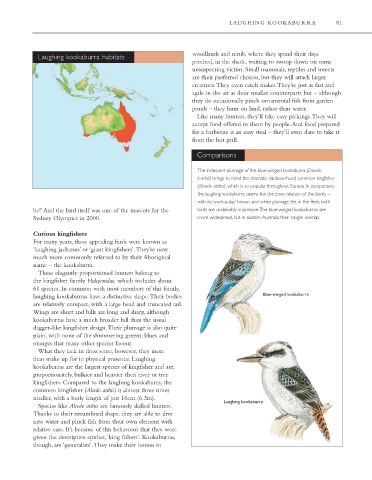
                                                                     Comparisons

                                                                     The iridescent plumage of the blue-winged kookaburra (Dacelo
                                                                     leachii) brings to mind the dramatic rainbow-hued common kingfisher
                                                                     (Alcedo atthis), which is so popular throughout Eurasia. In comparison,
                                                                     the laughing kookaburra seems like the poor relation of the family –
                                                                     with its ‘work-a-day’ brown and white plumage.Yet, in the flesh, both
             be!’And the bird itself was one of the mascots for the  birds are undeniably impressive.The blue-winged kookaburras are
             Sydney Olympics in 2000.                                more widespread, but in eastern Australia their ranges overlap.


             Curious kingfishers
             For many years, these appealing birds were known as
             ‘laughing jackasses’ or ‘giant kingfishers’.They’re now
             much more commonly referred to by their Aboriginal
             name – the kookaburra.
              These elegantly proportioned hunters belong to
             the kingfisher family Halcyonidae, which includes about
             61 species. In common with most members of this family,
             laughing kookaburras have a distinctive shape.Their bodies                     Blue-winged kookaburra
             are relatively compact, with a large head and truncated tail.
             Wings are short and bills are long and sharp, although
             kookaburras have a much broader bill than the usual
             dagger-like kingfisher design.Their plumage is also quite
             plain, with none of the shimmering greens, blues and
             oranges that many other species favour.
              What they lack in dress sense, however, they more
             than make up for in physical presence. Laughing
             kookaburras are the largest species of kingfisher and are,
             proportionately, bulkier and heavier then river or tree
             kingfishers. Compared to the laughing kookaburra, the
             common kingfisher (Alcedo atthis) is almost three times
             smaller, with a body length of just 16cm (6.3in).
                                                                              Laughing kookaburra
              Species like Alcedo atthis are famously skilled hunters.
             Thanks to their streamlined shape. they are able to dive
             into water and pluck fish from their own element with
             relative ease. It’s because of this behaviour that they were
             given the descriptive epithet,‘king fishers’. Kookaburras,
             though, are ‘generalists’.They make their homes in


                                             (c) 2011 Marshall Cavendish. All Rights Reserved.

