


Page 77 - Atlas Of The World's Strangest Animals
P. 77
KOALA         77


             America, which was still attached to Eurasia at that point.
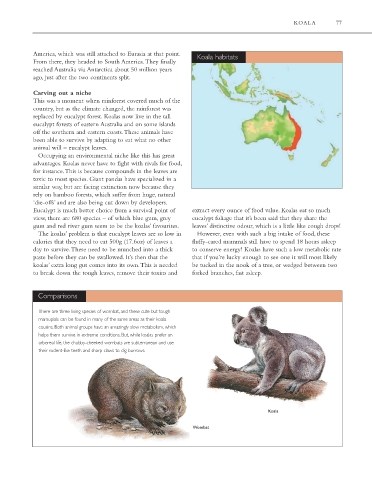
                                                                     Koala habitats
             From there, they headed to South America.They finally
             reached Australia via Antarctica about 50 million years
             ago, just after the two continents split.


             Carving out a niche
             This was a moment when rainforest covered much of the
             country, but as the climate changed, the rainforest was
             replaced by eucalypt forest. Koalas now live in the tall
             eucalypt forests of eastern Australia and on some islands
             off the southern and eastern coasts.These animals have
             been able to survive by adapting to eat what no other
             animal will – eucalypt leaves.
              Occupying an environmental niche like this has great
             advantages. Koalas never have to fight with rivals for food,
             for instance.This is because compounds in the leaves are
             toxic to most species. Giant pandas have specialized in a
             similar way, but are facing extinction now because they
             rely on bamboo forests, which suffer from huge, natural
             ‘die-offs’ and are also being cut down by developers.
             Eucalypt is much better choice from a survival point of  extract every ounce of food value. Koalas eat so much
             view, there are 680 species – of which blue gum, grey  eucalypt foliage that it’s been said that they share the
             gum and red river gum seem to be the koalas’ favourites.  leaves’ distinctive odour, which is a little like cough drops!
              The koalas’ problem is that eucalypt leaves are so low in  However, even with such a big intake of food, these
             calories that they need to eat 500g (17.6oz) of leaves a  fluffy-eared mammals still have to spend 18 hours asleep
             day to survive.These need to be munched into a thick   to conserve energy! Koalas have such a low metabolic rate
             paste before they can be swallowed. It’s then that the  that if you’re lucky enough to see one it will most likely
             koalas’ extra long gut comes into its own.This is needed  be tucked in the nook of a tree, or wedged between two
             to break down the tough leaves, remove their toxins and  forked branches, fast asleep.


              Comparisons


              There are three living species of wombat, and these cute but tough
              marsupials can be found in many of the same areas as their koala
              cousins. Both animal groups have an amazingly slow metabolism, which
              helps them survive in extreme conditions. But, while koalas prefer an
              arboreal life, the chubby-cheeked wombats are subterranean and use
              their rodent-like teeth and sharp claws to dig burrows.


                                                                                              Koala


                                                                    Wombat


                                             (c) 2011 Marshall Cavendish. All Rights Reserved.

