


Page 92 - Atlas Of The World's Strangest Animals
P. 92
92       ATLAS  OF THE WORLD’S  STRANGEST ANIMALS


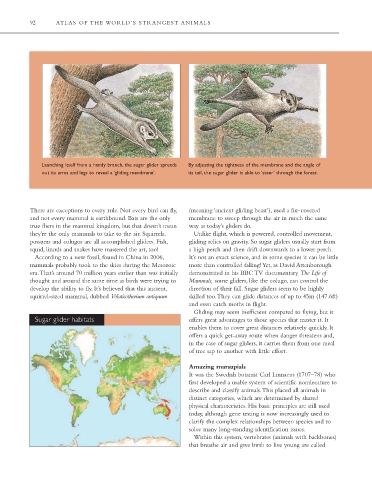
                Launching itself from a handy branch, the sugar glider spreads  By adjusting the tightness of the membrane and the angle of
                out its arms and legs to reveal a ‘gliding membrane’.  its tail, the sugar glider is able to ‘steer’ through the forest.


           There are exceptions to every rule. Not every bird can fly,  (meaning ‘ancient gliding beast’), used a fur-covered
           and not every mammal is earthbound. Bats are the only  membrane to sweep through the air in much the same
           true fliers in the mammal kingdom, but that doesn’t mean  way as today’s gliders do.
           they’re the only mammals to take to the air. Squirrels,  Unlike flight, which is powered, controlled movement,
           possums and colugos are all accomplished gliders. Fish,  gliding relies on gravity. So sugar gliders usually start from
           squid, lizards and snakes have mastered the art, too!  a high perch and then drift downwards to a lower perch.
             According to a new fossil, found in China in 2006,   It’s not an exact science, and in some species it can be little
           mammals probably took to the skies during the Mesozoic  more than controlled falling! Yet, as David Attenborough
           era.That’s around 70 million years earlier than was initially  demonstrated in his BBC TV documentary The Life of
           thought and around the same time as birds were trying to  Mammals, some gliders, like the colugo, can control the
           develop the ability to fly. It’s believed that this ancient,  direction of their fall. Sugar gliders seem to be highly
           squirrel-sized mammal, dubbed Volaticotherium antiquum  skilled too.They can glide distances of up to 45m (147.6ft)
                                                                  and even catch moths in flight.
                                                                    Gliding may seem inefficient compared to flying, but it
             Sugar glider habitats                                offers great advantages to those species that master it. It
                                                                  enables them to cover great distances relatively quickly. It
                                                                  offers a quick get-away route when danger threatens and,
                                                                  in the case of sugar gliders, it carries them from one meal
                                                                  of tree sap to another with little effort.


                                                                  Amazing marsupials
                                                                  It was the Swedish botanist Carl Linnaeus (1707–78) who
                                                                  first developed a usable system of scientific nomlecature to
                                                                  describe and classify animals.This placed all animals in
                                                                  distinct categories, which are determined by shared
                                                                  physical characteristics. His basic principles are still used
                                                                  today, although gene testing is now increasingly used to
                                                                  clarify the complex relationships between species and to
                                                                  solve many long-standing identification issues.
                                                                    Within this system, vertebrates (animals with backbones)
                                                                  that breathe air and give birth to live young are called


                                             (c) 2011 Marshall Cavendish. All Rights Reserved.

