


Page 89 - Atlas Of The World's Strangest Animals
P. 89
SHORT-BEAKED ECHIDNA                89


             live young. Membership of this elite clique is limited   plates are made from keratin – the same material as in
             to just the platypuses and the echidnas.Although both  human fingernails – and they are tough enough to grind
             share common ancestors, the echidna branch of the      up even the biggest, crunchiest termite with ease!
             family diverged 19–48 million years ago and, in the     The echidnas’ leathery snout is covered in sensitive
             process, developed some quite surprising and           receptors, which provide them with information about
             sophisticated characteristics.                         their surrounding environment.They have an extremely
              For instance, echidnas have no teeth.They don’t need  well-developed sense of smell and excellent vision.They
             them! Their short limbs and powerful front claws are   have bigger brains than similar-sized creatures along with
             perfect for digging and tearing open rotting logs, termite  a highly developed cerebral cortex.This is the area of the
             mounds and ant hills. Once inside, echidna need only lap  brain responsible for attention, perception and memory.
             up the contents with speedy flicks of their tongue.Tiny  Studies have shown that echidnas have superb memories
             spines on the tongue help to catch the insects, and when  and excellent spatial awareness. So it seems to be no fluke
             the tongue is retracted, these are caught on backwards-  that this ancient line of mammals has managed to survive
             facing ‘plates’ that sit on the roof of the mouth.These  the pressures of life in the twenty-first century.


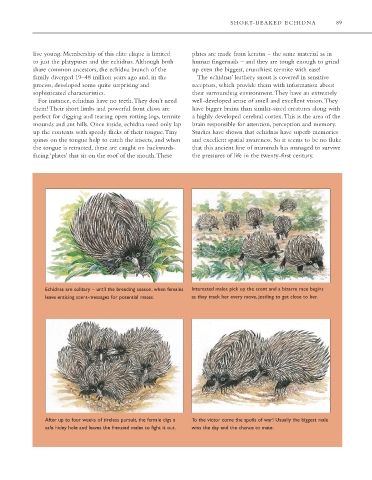
                 Echidnas are solitary – until the breeding season,when females  Interested males pick up the scent and a bizarre race begins
                 leave enticing scent-messages for potential mates.  as they track her every move,jostling to get close to her.


                 After up to four weeks of tireless pursuit, the female digs a  To the victor come the spoils of war! Usually the biggest male
                 safe hidey hole and leaves the frenzied males to fight it out.  wins the day and the chance to mate.


                                             (c) 2011 Marshall Cavendish. All Rights Reserved.

