


Page 93 - Atlas Of The World's Strangest Animals
P. 93
SUGAR GLIDER            93


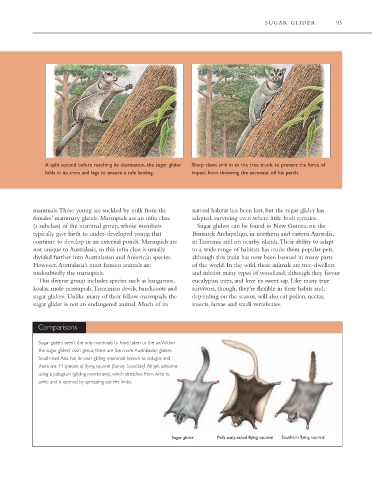
                 A split second before reaching its destination, the sugar glider  Sharp claws sink in to the tree trunk, to prevent the force of
                 folds in its arms and legs to ensure a safe landing.  impact from throwing the aeronaut off his perch.


             mammals.These young are suckled by milk from the       natural habitat has been lost, but the sugar glider has
             females’ mammary glands. Marsupials are an infra class   adapted, surviving even where little bush remains.
             (a subclass) of the mammal group, whose members         Sugar gliders can be found in New Guinea, on the
             typically give birth to under-developed young that     Bismarck Archipelago, in northern and eastern Australia,
             continue to develop in an external pouch. Marsupials are  in Tasmania and on nearby islands.Their ability to adapt
             not unique to Australasia, so this infra class is usually  to a wide range of habitats has made them popular pets,
             divided further into Australasian and American species.  although this trade has now been banned in many parts
             However,Australasia’s most famous animals are          of the world. In the wild, these animals are tree-dwellers
             undoubtedly the marsupials.                            and inhabit many types of woodland, although they favour
              This diverse group includes species such as kangaroos,  eucalyptus trees, and love its sweet sap. Like many true
             koalas, mole marsupials,Tasmanian devils, bandicoots and  survivors, though, they’re flexible in their habits and,
             sugar gliders. Unlike many of their fellow marsupials, the  depending on the season, will also eat pollen, nectar,
             sugar glider is not an endangered animal. Much of its  insects, larvae and small vertebrates.


              Comparisons


              Sugar gliders aren’t the only mammals to have taken to the air.Within
              the sugar gliders’ own genus, there are five more Australasian gliders.
              South-east Asia has its own gliding mammals known as colugos and
              there are 44 species of flying squirrel (family Sciuridae).All get airborne
              using a patagium (gliding membrane), which stretches from wrist to
              ankle and is opened by spreading out the limbs.


                                                            Sugar glider    Pel’s scaly-tailed flying squirrel  Southern flying squirrel


                                             (c) 2011 Marshall Cavendish. All Rights Reserved.

