


Page 88 - Atlas Of The World's Strangest Animals
P. 88
88       ATLAS  OF THE WORLD’S  STRANGEST ANIMALS


             Comparisons

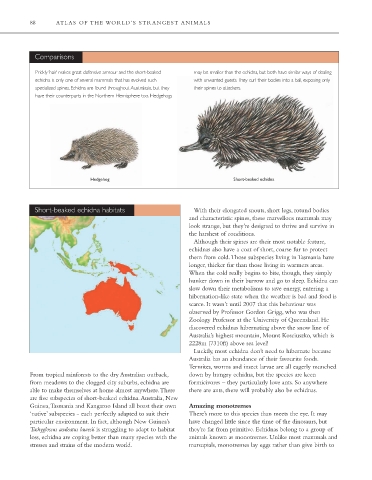
             Prickly ‘hair’ makes great defensive armour and the short-beaked  may be smaller than the echidna, but both have similar ways of dealing
             echidna is only one of several mammals that has evolved such  with unwanted guests.They curl their bodies into a ball, exposing only
             specialized spines. Echidna are found throughout Australasia, but they  their spines to attackers.
             have their counterparts in the Northern Hemisphere too. Hedgehogs


                                Hedgehog                                          Short-beaked echidna


             Short-beaked echidna habitats                          With their elongated snouts, short legs, rotund bodies
                                                                  and characteristic spines, these marvellous mammals may
                                                                  look strange, but they’re designed to thrive and survive in
                                                                  the harshest of conditions.
                                                                    Although their spines are their most notable feature,
                                                                  echidnas also have a coat of short, coarse fur to protect
                                                                  them from cold.Those subspecies living in Tasmania have
                                                                  longer, thicker fur than those living in warmers areas.
                                                                  When the cold really begins to bite, though, they simply
                                                                  hunker down in their burrow and go to sleep. Echidna can
                                                                  slow down their metabolisms to save energy, entering a
                                                                  hibernation-like state when the weather is bad and food is
                                                                  scarce. It wasn’t until 2007 that this behaviour was
                                                                  observed by Professor Gordon Grigg, who was then
                                                                  Zoology Professor at the University of Queensland. He
                                                                  discovered echidnas hibernating above the snow line of
                                                                  Australia’s highest mountain, Mount Kosciuszko, which is
                                                                  2228m (7310ft) above sea level!
                                                                    Luckily, most echidna don’t need to hibernate because
                                                                  Australia has an abundance of their favourite foods.
                                                                  Termites, worms and insect larvae are all eagerly munched
           From tropical rainforests to the dry Australian outback,  down by hungry echidna, but the species are keen
           from meadows to the clogged city suburbs, echidna are  formicivores – they particularly love ants. So anywhere
           able to make themselves at home almost anywhere.There  there are ants, there will probably also be echidnas.
           are five subspecies of short-beaked echidna.Australia, New
           Guinea,Tasmania and Kangaroo Island all boast their own  Amazing monotremes
           ‘native’ subspecies - each perfectly adapted to suit their  There’s more to this species than meets the eye. It may
           particular environment. In fact, although New Guinea’s  have changed little since the time of the dinosaurs, but
           Tachyglossus aculeatus lawesii is struggling to adapt to habitat  they’re far from primitive. Echidnas belong to a group of
           loss, echidna are coping better than many species with the  animals known as monotremes. Unlike most mammals and
           stresses and strains of the modern world.              marsupials, monotremes lay eggs rather than give birth to


                                             (c) 2011 Marshall Cavendish. All Rights Reserved.

