


Page 265 - (DK Eyewitness) Travel Guide - Greek Islands
P. 265
Must See
       5 "
         PHAISTOS


       ΤΟ ΑΝΑΚΤΟΡΟ ΤΗΣ ΦΑΙΣΤΟΎ

       ⌂ 65 km (40 miles) SW of Iráklio   § 28920 42315   # Hours vary,
       check website   ¢ Main public hols   ∑ odysseus.culture.gr
       One of four great Minoan palaces discovered on Crete, Phaistos was
       first excavated by Italian archaeologist Federico Halbherr between
       1884 and 1904, who unearthed two palaces on site. Situated south of
       Iráklio on the Messara plain, Phaistos is backed by Mount Ida.

       Remains of the first palace, constructed
       around 1900 BC and destroyed by an
       earthquake in 1700 BC, are still visible.
       However, most of the present ruins are of the
       second palace, which was severely damaged
       around 1450 BC, possibly by a tidal wave.
       Although a large number of inscriptions were
       found on site, they are all in Linear A script,
       which remains largely undeciphered. This, and
       the superimposed ruins of the two palaces,
       have made it more challenging to discover
       who lived on the site.
         Phaistos was the second largest palace in
       Minoan Crete. Unlike at larger Knosós (p260),
       where the ruins were creatively interpreted
       and partially rebuilt by Sir
       Arthur Evans, Phaistos
       remains an archaeological
       site. Visitors, free to wander
       around the site, can imagine
       the structure of the
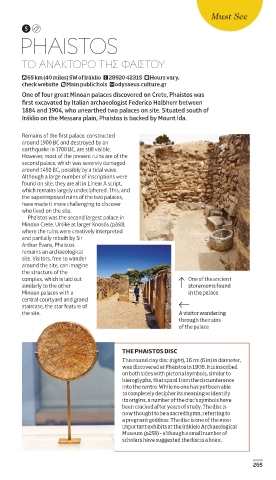
       complex, which is laid out                One of the ancient
       similarly to the other                    storerooms found
       Minoan palaces with a                     in the palace
       central courtyard and grand
       stair case, the star feature of
       the site.                               A visitor wandering
                                               through the ruins
                                               of the palace


                                THE PHAISTOS DISC
                                This round clay disc (right), 16 cm (6 in) in diameter,
                                was discovered at Phaistos in 1908. It is inscribed
                                on both sides with pictorial symbols, similar to
                                hieroglyphs, that spiral from the circumference
                                into the centre. While no one has yet been able
                                to completely decipher its meaning or identify
                                its origins, a number of the disc’s symbols have
                                been cracked after years of study. The disc is
                                now thought to be a sacred hymn, referring to
                                a pregnant goddess. The disc is one of the most
                                important exhibits at the Irákleio Archaeological
                                Museum (p258) – although a small number of
                                scholars have suggested the disc is a hoax.


                                                                  265


   264-265_EW_Greek_Islands.indd   265                       28/11/2018   09:56

