


Page 25 - All About History - Issue 18-14
P. 25
Mass Media


                              How do we know this?                                     PROVIDE MEDICAL CARE
                              A variety of sources document the roles undertaken       The monasteries were an important part of the
                              by monks in the Middle Ages. Life In The Medieval        medieval communities and would provide the
                              Cloister by Julie Kerr gives a fascinating insight       only source of medical treatment to many villages
                              into the daily lives of the monks. Using chronicles      as well as war casualties. Monks would be trained
                              and letters from the period, the book provides a
                              personal touch through the monks’ own words.             in the art of medicine – often through books that
                              For an insight into the rules dictating the lives of     they themselves had read and copied so that other
                              Benedictine monks there is no better source than         generations could make use of the knowledge – and
                              The Rule Of Benedict, written by St Benedict himself,    offered their services from a hospital attached to the
                              which has guided monks for 15 centuries.
                                                                                       monastery. Monks were known to amputate limbs,
                                                                                       induce birth and cure scurvy.


                                                                                       GATHER FOR DINNER
                                                                                       Meals were eaten twice a day, in the morning and
                                                                                       at midday, while from late spring to early autumn
                                                                                       supper would also be served. The monks would
                                                                                       gather in a large refectory and eat in silence as Bible
                                                                                       passages were read by one their order – in a time
                                                                                       when most of the population were illiterate, monks
                                                                                       could read and write. As it was forbidden to eat
                                                                                       four-legged animals, the meals were simple, largely
                                                                                       consisting of bread and ale, which was drunk at
                                                                                       every meal.


                                                                                       PRIVATE REFLECTION
                                                                                       A monk’s life was first and foremost dedicated to
                                                                                       prayer and worship and every day time would be
                                                                                       set aside for private reflection and meditation. Strict
                                                                                       silence was expected and two elders would patrol
                                                                                       the monastery to ensure this was upheld. Anyone
                                                                                       seen being idle, speaking or, even worse, cracking
                                                                                       jokes would be harshly disciplined with beatings or
                                                                                       forced seclusion.
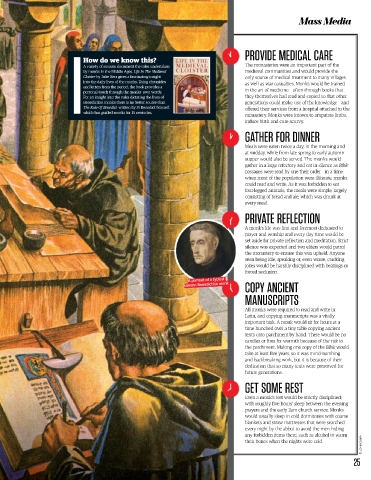
                                                                   A portrait of a typical
                                                                  solemn Benedictine monk
                                                                                       COPY ANCIENT

                                                                                       MANUSCRIPTS
                                                                                       All monks were required to read and write in
                                                                                       Latin, and copying manuscripts was a vitally
                                                                                       important task. A monk would sit for hours at a
                                                                                       time hunched over a tiny table copying ancient
                                                                                       texts onto parchment by hand. There would be no
                                                                                       candles or fires for warmth because of the risk to
                                                                                       the parchment. Making one copy of the Bible would
                                                                                       take at least five years, so it was mind-numbing
                                                                                       and backbreaking work, but it is because of their
                                                                                       dedication that so many texts were preserved for
                                                                                       future generations.


                                                                                       GET SOME REST
                                                                                       Even a monk’s rest would be strictly disciplined;
                                                                                       with roughly five hours’ sleep between the evening
                                                                                       prayers and the early 2am church service. Monks
                                                                                       would usually sleep in cold dormitories with coarse
                                                                                       blankets and straw mattresses that were searched
                                                                                       every night by the abbot to avoid the men hiding
                                                                                       any forbidden items there, such as alcohol to warm
                                                                                                                                © Look and Learn
                                                                                       their bones when the nights were cold.


                                                                                                                             25

