


Page 40 - The Book of Caterpillars: A Life-Size Guide to Six Hundred Species From Around the World
P. 40
BUTTERFLY CATERPILLARS

                                                     FAMILY  Papilionidae
                                                 DISTRIBUTION
                                                 DISTRIBUTION  Eastern Europe to the Middle East, Armenia to Turkmenistan
                                                   TRIBUTION
                                                 DIS
                                                    HABITAT
                                                    HABIT A T  Rocky slopes, olive groves, and vineyards
                                                    HABITAT
                                                  HOS T PLANT S  Pipevine (Aristolochia spp.)
                                                  HOST PLANTS
                                                  HOST PLANTS
                                                      NO
                                                      NOTE
                                                       TE
                                                      NOTE  Brightly colored caterpillar that hides in leaf bags
                                             CONSERVATION STATUS
                                             CONSERVATION STATUS
                                             CONSERV A TION S T A TUS  Near threatened
            ADULT WINGSPAN
           2⅛–2⅜ in (54–60 mm)
           CATERPILLAR LENGTH
           Up to 1⅞ in (48 mm)
                                                                           ARCHON APOLLINUS
                                                                    FALSE APOLLO
    38
                                                                                    (HERBST, 1789)


                                            Female False Apollo butterflies lay round, green eggs on
                                            the underside of leaves, and the young caterpillars appear in
                                            April and May. At first they are gregarious, living together
                                            in leaf webs, but as they get older they move apart and
                                            shelter in individual leaf bags, a feature not seen in other
                                            European swallowtail species. The mature caterpillars crawl
                                            to the ground, where they pupate just below the surface in
                                            a loose cocoon. They overwinter and emerge in spring.
                                            The adults are on the wing from March to April; a single
                                            generation is produced annually.


                                            Archon apollinus is a variable species with up to five subspecies.
                                            Characteristically, the adults lose their wing scales as they age,
                                            leaving transparent areas of wing, especially on the forewings;
                                            in older specimens the forewings may be completely transparent.
                                            The species is under threat from herbicide sprays that kill its
                                            host plants, surviving better in the less intensively farmed
                                            regions of Turkmenistan.


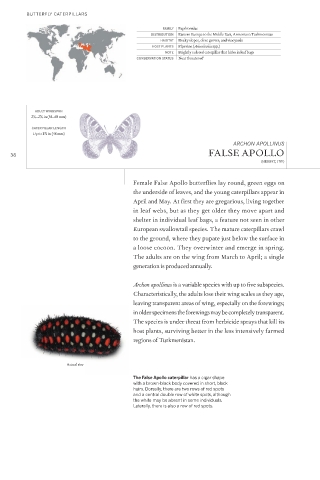
                      Actual size

                                            The False Apollo caterpillar has a cigar shape
                                            with a brown-black body covered in short, black
                                            hairs. Dorsally, there are two rows of red spots
                                            and a central double row of white spots, although
                                            the white may be absent in some individuals.
                                            Laterally, there is also a row of red spots.

