


Page 43 - The Book of Caterpillars: A Life-Size Guide to Six Hundred Species From Around the World
P. 43
BUTTERFLY CATERPILLARS
FAMILY Papilionidae
DISTRIBUTION Throughout eastern United States
HABITAT Normally in moist woodlands, but will visit flowers in open areas
HOST PLANTS Pawpaw (Asimina spp.)
NOTE Caterpillar protected by the host plant chemicals it ingests
CONSERVATION STATUS Not evaluated, but common
ADULT WINGSPAN
2½–4⁄ in (64–104 mm)
CATERPILLAR LENGTH
1¾–2⅛ in (45–55 mm)
EURYTIDES MARCELLUS
ZEBRA SWALLOWTAIL 41
(CRAMER, 1777)
Zebra Swallowtail caterpillars hatch in the spring and the fall,
and feed on the underside of the host plant leaves. Like most
other swallowtail larvae, they have osmeteria, which are everted
when the caterpillars are disturbed. These organs look like
horns and have a strong smell, produced by the isobutyric and
2-methyl butyric acids that the larvae absorb from the host plant.
The smell effectively repels ants and spiders. Younger larvae
may also fall from the plant if disturbed.
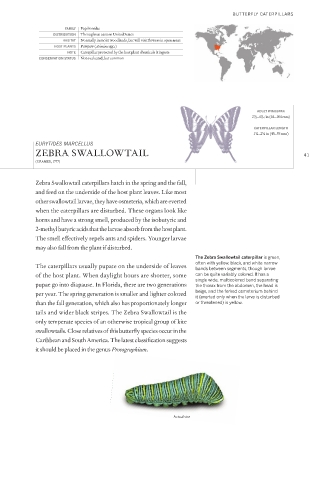
The Zebra Swallowtail caterpillar is green,
The caterpillars usually pupate on the underside of leaves often with yellow, black, and white narrow
bands between segments, though larvae
of the host plant. When daylight hours are shorter, some can be quite variably colored. It has a
pupae go into diapause. In Florida, there are two generations single wide, multicolored band separating
the thorax from the abdomen, the head is
per year. The spring generation is smaller and lighter colored beige, and the forked osmeterium behind
it (everted only when the larva is disturbed
than the fall generation, which also has proportionately longer or threatened) is yellow.
tails and wider black stripes. The Zebra Swallowtail is the
only temperate species of an otherwise tropical group of kite
swallowtails. Close relatives of this butterfly species occur in the
Caribbean and South America. The latest classification suggests
it should be placed in the genus Protographium.
Actual size

