


Page 45 - The Book of Caterpillars: A Life-Size Guide to Six Hundred Species From Around the World
P. 45
BUTTERFLY CATERPILLARS
FAMILY Papilionidae
DISTRIBUTION Europe, across central Asia to China, Korea, and Japan
HABITAT Woodlands, orchards, field margins, dry grassland, parks,
and gardens
HOST PLANTS Shrubs, including Blackthorn (Prunus spinosa) and other
Prunus spp., hawthorn (Crataegus spp.), apple (Malus spp.),
and Sorbus spp.
NOTE Well-camouflaged caterpillar that lays a silken trail
CONSERVATION STATUS Not evaluated, but considered endangered in some parts
of its range
ADULT WINGSPAN
2⁄–3½ in (69–90 mm)
CATERPILLAR LENGTH
2 in (50 mm)
IPHICLIDES PODALIRIUS
SCARCE SWALLOWTAIL 43
(LINNAEUS, 1758)
Scarce Swallowtail caterpillars hatch from pale, round eggs laid
singly by the female butterfly on the underside of the host plant
leaves. The larvae live sedentary and solitary lives, spinning a
silk cushion on leaves on which to rest. When they move across
the host plant to feed, they leave a trail of silk threads that allow
them to retrace the route to their resting place. The pupa is
either yellow green or brown. Caterpillars produced early in
the season are yellow green and found on the host plant, while
those pupating late in the season are brown and found in the
leaf litter, where they overwinter. This difference is known as
a seasonal polymorphism.
The adults are on the wing from March to October, and there
are three generations a year. Despite its common name, the
species is widespread and generally plentiful, but in some areas
it is declining due to loss of habitat, especially its preferred
Blackthorn hedges.
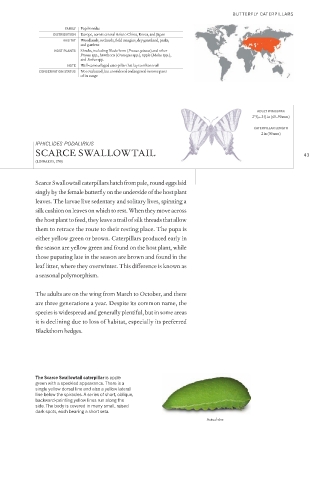
The Scarce Swallowtail caterpillar is apple
green with a speckled appearance. There is a
single yellow dorsal line and also a yellow lateral
line below the spiracles. A series of short, oblique,
backward-pointing yellow lines run along the
side. The body is covered in many small, raised
dark spots, each bearing a short seta.
Actual size

