


Page 35 - The Book of Caterpillars: A Life-Size Guide to Six Hundred Species From Around the World
P. 35
RESEARCH AND CONSERVATION


            LEPIDOPTERA CONSERVATION

            Worldwide, habitat loss is the principal threat to Lepidoptera, with some
            species in steep decline. At the root of the problem are urban development,
            agricultural expansion, and forest clearance, erasing the natural, wild
            terrain where eggs are laid, caterpillars feed, develop, and pupate, and adult

            moths and butterflies eclose and breed. Around 10 percent of butterfly
            species in Europe face extinction, according to the United Kingdom charity
            Butterfly Conservation. In the United Kingdom, especially the south, moth
            numbers have declined by up to 40 percent over the past 50 years.
            Populations of the most familiar North American butterfly, the Monarch

            (Danaus plexippus), have contracted by 80 to 90 percent in two decades.
                                                                                                  33
               In response, conservation groups have launched community efforts to                33
            save endangered butterflies, such as the Richmond Birdwing (Ornithoptera
            richmondia)—the focus of recovery projects in Australia. In the United

            States, more than 15,000 waystations containing nectar and caterpillar host
            plants for Monarch butterflies have been established. A reduction in the
            use of pesticides is helping, and some farmers in Europe, the United States,
            and New Zealand are incorporating a nature reserve element within their
            landscape strategy, which could further boost Lepidoptera numbers.
               Rearing caterpillars is at the center of United States penitentiary-based

            conservation efforts aimed at restoring populations of Taylor’s Checkerspot
            butterfly (Euphydryas editha taylori) in Oregon and Washington State.
            Thousands of Monarch caterpillars are reared annually by inmates at
            Washington State Penitentiary, who tag the butterflies, before release, to

            help provide data on migration routes and destinations. One prison
            inmate reportedly said, “Watching a caterpillar transform itself into a
            butterfly proves to me that I can change too,” showing that, even in the
            more unlikely places, the miracle of Lepidoptera metamorphosis remains
            a source of inspiration.


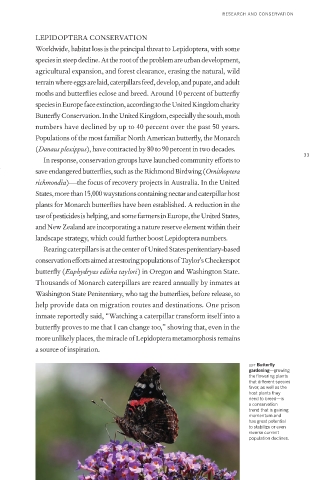
                                                                                left Butterfly
                                                                                gardening—growing
                                                                                the flowering plants
                                                                                that different species
                                                                                favor, as well as the
                                                                                host plants they
                                                                                need to breed—is
                                                                                a conservation
                                                                                trend that is gaining
                                                                                momentum and
                                                                                has great potential
                                                                                to stabilize or even
                                                                                reverse current
                                                                                population declines.

