


Page 22 - (DK Eyewitness) Travel Guide - New York City
P. 22
20 INTRODUCING NE W Y ORK CIT Y
Early New York City
Manhattan was a forested land populated by Algonquians
when the Dutch West India Company established a
fur-trading post called New Amsterdam in 1625. The
first settlers built houses helter-skelter, so even today
the streets of Lower Manhattan still twist. Broadway, then
called by the Dutch name Breede Wegh, began as a Native
American trail known as the Weekquaesgeek Growth of the Metropolis
Trail. Harlem has also kept its Dutch 1664 Today
name. The town was unruly until Peter
Stuyvesant arrived to bring order.
But the colony did not produce the Seal of New Netherland
expected revenues, and in 1664 The beaver pelt and wampum
(shell beads) on the seal were
the Dutch let it fall to the English, the currency of the colony of
who renamed it New York. New Netherland.
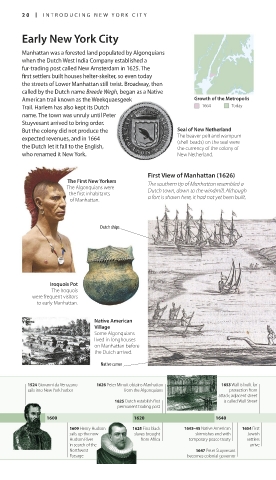
First View of Manhattan (1626)
The First New Yorkers
The Algonquians were The southern tip of Manhattan resembled a
the first inhabitants Dutch town, down to the windmill. Although
of Manhattan. a fort is shown here, it had not yet been built.
Dutch ships
Iroquois Pot
The Iroquois
were frequent visitors
to early Manhattan.
Native American
Village
Some Algonquians
lived in longhouses
on Manhattan before
the Dutch arrived.
Native canoe
1524 Giovanni da Verrazano 1626 Peter Minuit obtains Manhattan 1653 Wall is built for
sails into New York harbor from the Algonquians protection from
attack; adjacent street
1625 Dutch establish first is called Wall Street
permanent trading post
1600 1620 1640
1609 Henry Hudson 1625 First black 1643–45 Native American 1654 First
sails up the now slaves brought skirmishes end with Jewish
Hudson River from Africa temporary peace treaty settlers
in search of the arrive
Northwest 1647 Peter Stuyvesant
Passage becomes colonial governor
020-021_EW_New_York_City.indd 20 4/3/17 11:10 AM

