


Page 26 - (DK Eyewitness) Travel Guide - New York City
P. 26
24 INTRODUCING NE W Y ORK CIT Y
Revolutionary New York City
Dug up into trenches for defense, heavily shelled by British
troops, and scarred by recurring fires, New York suffered
during the American Revolution. But, despite
the hardships, many continued to enjoy
cricket games, horse races, boxing matches,
and balls. After the British took the city in
1776, it became their headquarters. The Growth of the Metropolis
Continental army did not return to 1776 Today
Manhattan until November 25, 1783,
two years after the fighting ended.
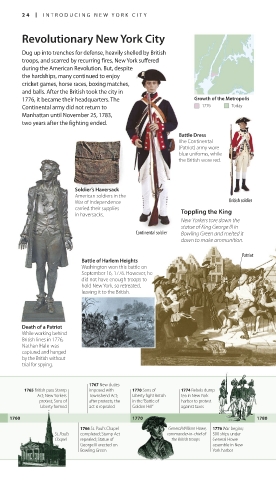
Battle Dress
The Continental
(Patriot) army wore
blue uniforms, while
the British wore red.
Soldier’s Haversack
American soldiers in the
War of Independence British soldier
carried their supplies
in haversacks. Toppling the King
New Yorkers tore down the
statue of King George III in
Continental soldier Bowling Green and melted it
down to make ammunition.
Patriot
Battle of Harlem Heights
Washington won this battle on
September 16, 1776. However, he
did not have enough troops to
hold New York, so retreated,
leaving it to the British.
Death of a Patriot
While working behind
British lines in 1776,
Nathan Hale was
captured and hanged
by the British without
trial for spying.
1767 New duties
1765 British pass Stamp imposed with 1770 Sons of 1774 Rebels dump
Act; New Yorkers Townshend Act; Liberty fight British tea in New York
protest; Sons of after protests, the in the “Battle of harbor to protest
Liberty formed act is repealed Golden Hill” against taxes
1760 1770 1780
1766 St. Paul’s Chapel General William Howe, 1776 War begins;
St. Paul’s completed; Stamp Act commander-in-chief of 500 ships under
Chapel repealed; Statue of the British troops General Howe
George III erected on assemble in New
Bowling Green York harbor
024-025_EW_New_York_City.indd 24 4/3/17 11:10 AM

