


Page 24 - (DK Eyewitness) Travel Guide - New York City
P. 24
22 INTRODUCING NE W Y ORK CIT Y
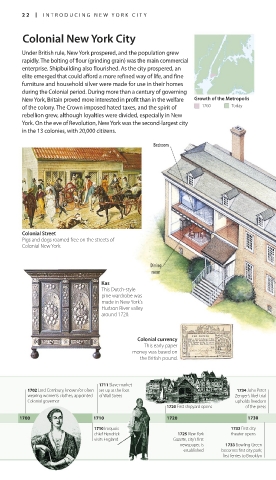
Colonial New York City
Under British rule, New York prospered, and the population grew
rapidly. The bolting of flour (grinding grain) was the main commercial
enterprise. Shipbuilding also flourished. As the city prospered, an
elite emerged that could afford a more refined way of life, and fine
furniture and household silver were made for use in their homes
during the Colonial period. During more than a century of governing
New York, Britain proved more interested in profit than in the welfare Growth of the Metropolis
of the colony. The Crown imposed hated taxes, and the spirit of 1760 Today
rebellion grew, although loyalties were divided, especially in New
York. On the eve of Revolution, New York was the second-largest city
in the 13 colonies, with 20,000 citizens.
Bedroom
Colonial Street
Pigs and dogs roamed free on the streets of
Colonial New York.
Dining
room
Kas
This Dutch-style
pine wardrobe was
made in New York’s
Hudson River valley
around 1720.
Colonial currency
This early paper
money was based on
the British pound.
1711 Slave market
1702 Lord Cornbury, known for often set up at the foot 1734 John Peter
wearing women’s clothes, appointed of Wall Street Zenger’s libel trial
Colonial governor upholds freedom
1720 First shipyard opens of the press
1700 1710 1720 1730
1710 Iroquois 1732 First city
chief Hendrick 1725 New York theater opens
visits England Gazette, city’s first
newspaper, is 1733 Bowling Green
established becomes first city park;
first ferries to Brooklyn
022-023_EW_New_York_City.indd 22 4/3/17 11:10 AM

